
Logan Property Tax Records
Logan property tax records are maintained by Cache County, which handles all property assessment, billing, and collection for parcels in the city. Logan is the county seat of Cache County and home to Utah State University, which shapes much of the city's residential and rental property market. The city does not operate its own property tax office. All assessment functions belong to Cache County. This guide covers how to search Logan property tax records, how USU's presence affects local assessment patterns, what exemptions apply, and how to appeal if your value seems too high.
Logan Quick Facts
Cache County Assessor and Logan Property Records
The Cache County Assessor at cachecounty.org/assessor values all Logan parcels at 100% of fair market value as of January 1 each year. This is required by Utah Code Title 59, Chapter 2. Cache County's effective property tax rate of 0.52% is among the lower rates in Utah, and Logan's $942 median annual tax reflects the combination of that low rate and comparatively moderate home values. For property owners coming from higher-cost metro areas, Logan's tax burden is often a welcome surprise.
The Cache County Assessor's online search lets you look up any Logan parcel by address, owner name, or parcel number. Results show the assessed value split between land and improvements, taxable value after exemptions, ownership history, and legal description. The assessor uses recent local sales data to calibrate values for Logan's residential market, which includes older bungalows near the historic downtown, student rentals near USU, newer neighborhoods on the city's edges, and commercial properties along Main Street.
The official Logan city website at loganutah.gov provides access to city services, building permits, and planning resources relevant to property owners and developers in the city.
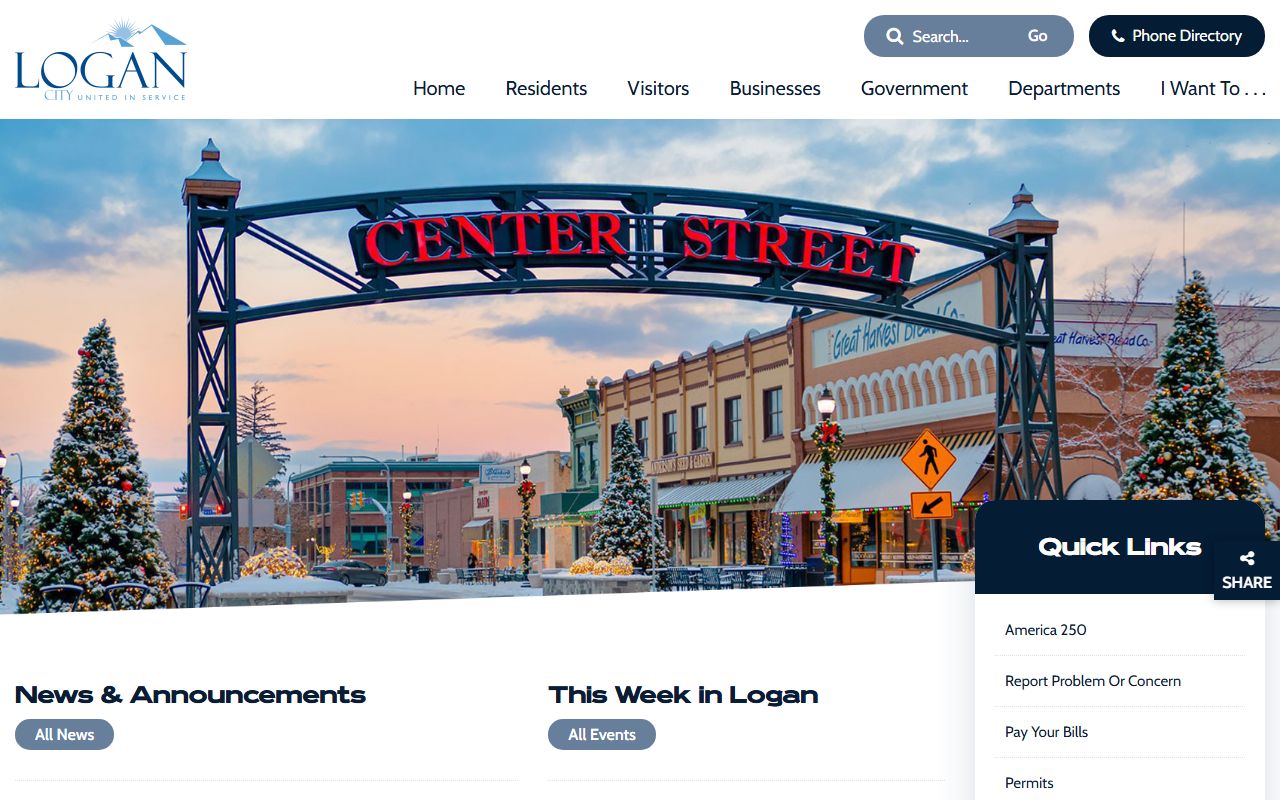
The Logan city portal connects to development and permit resources that inform how Cache County tracks and values properties throughout the city, including areas undergoing change through the Logan 2045 General Plan process.
How to Search Logan Property Tax Records
Start your search at the Cache County Assessor's portal at cachecounty.org/assessor. Enter the Logan property's address or parcel number to pull up the full record. You will see land value, improvement value, total assessed value, and taxable value after any exemption applied. The record also shows the owner's name and mailing address and the legal description of the parcel.
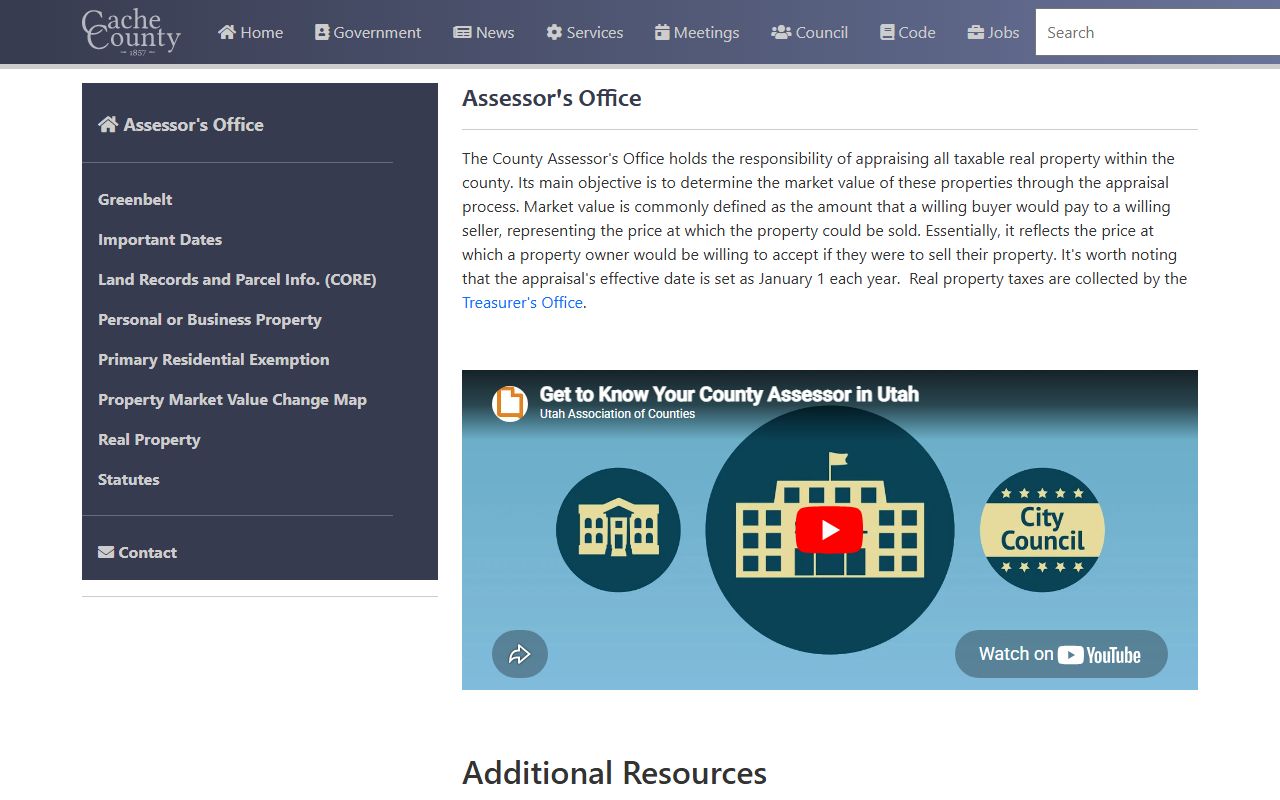
The Cache County Assessor's online portal provides parcel-level assessment data for all Logan properties, including ownership information and value breakdowns useful to homeowners and buyers alike.
The Cache County GIS portal at cachecounty.org/gis offers a map-based search for Logan parcels. Click on any lot on the map to view its assessment details, owner information, and parcel boundaries. This tool is useful when you need to identify a property by location rather than address. The GIS layer also shows zoning designations, which can be important when Logan's General Plan updates affect how properties are classified.
The Utah GIS portal at gis.utah.gov provides a statewide parcel layer covering all of Cache County. This tool pulls from the same county data that drives the assessor's own portal and is useful for map-based parcel research.
Logan, Utah State University, and Property Assessment
Utah State University is the dominant institution in Logan and shapes much of the city's property market. USU itself is tax-exempt as a state institution, so its large campus does not appear on the taxable assessment roll. However, the university's presence drives demand for student housing throughout the surrounding neighborhoods. This creates a large inventory of rental properties that are assessed at full market value without the primary residence exemption.
Rental homes near USU are assessed based on comparable residential sales rather than their rental income unless the income approach produces a higher value. For small student rentals in Logan, the sales approach typically applies. The assessor is aware of the rental market dynamics and calibrates values against actual Logan home sales data each year. If you own a rental near campus and believe the value is inflated relative to what similar homes sell for, that is worth investigating before the appeal deadline.
Logan is also currently developing its Logan 2045 General Plan, a long-range planning document that will shape zoning, density, and land use throughout the city. Changes in zoning that come from this process can affect property values and how parcels are classified. If your Logan property is in an area targeted for rezoning or increased density under the 2045 plan, that is worth tracking because a reclassification can lead to a higher assessed value once the county assessor updates its records.
Note: USU properties are centrally assessed by the state rather than the local assessor when they involve utility or statewide infrastructure. Most of the main campus is simply exempt from taxation as a public institution.
Logan Property Tax Exemptions
The 45% primary residence exemption is available to Logan homeowners who occupy their property as their main home. Under Utah Code Title 59, Chapter 2, owner-occupants pay tax on only 55% of the assessed value. The exemption is applied automatically when the assessor classifies the property as a primary residence. If you live in your Logan home and the exemption is not showing, contact the Cache County Assessor to correct it.
Many Logan properties near USU are rented to students and do not qualify for the primary residence exemption. If you own a home in Logan, live in it, and also rent out a room or basement unit, you may qualify for a partial exemption. Ask the assessor how they handle mixed-use owner-occupied and rental properties in Logan.
The Circuit Breaker program gives qualifying low-income elderly and disabled homeowners a partial refund of property taxes paid. Apply through the Utah State Tax Commission at tax.utah.gov/contact/property-tax by the annual deadline. Cache County's 0.52% rate is low compared to the state average, but fixed-income residents may still benefit from the Circuit Breaker if their income qualifies. Agricultural land in Cache County, including parcels on Logan's edges, may also qualify for reduced agricultural valuation.
Cache County Treasurer and Logan Tax Payments
The Cache County Treasurer at cachecounty.org/treasurer collects property taxes for all Logan parcels. Tax notices go out in the fall. The full amount is due by November 30. Pay online, by mail, or in person at the Cache County offices in Logan. The treasurer's portal shows your current balance, prior payments, and any outstanding delinquent amounts by parcel number.
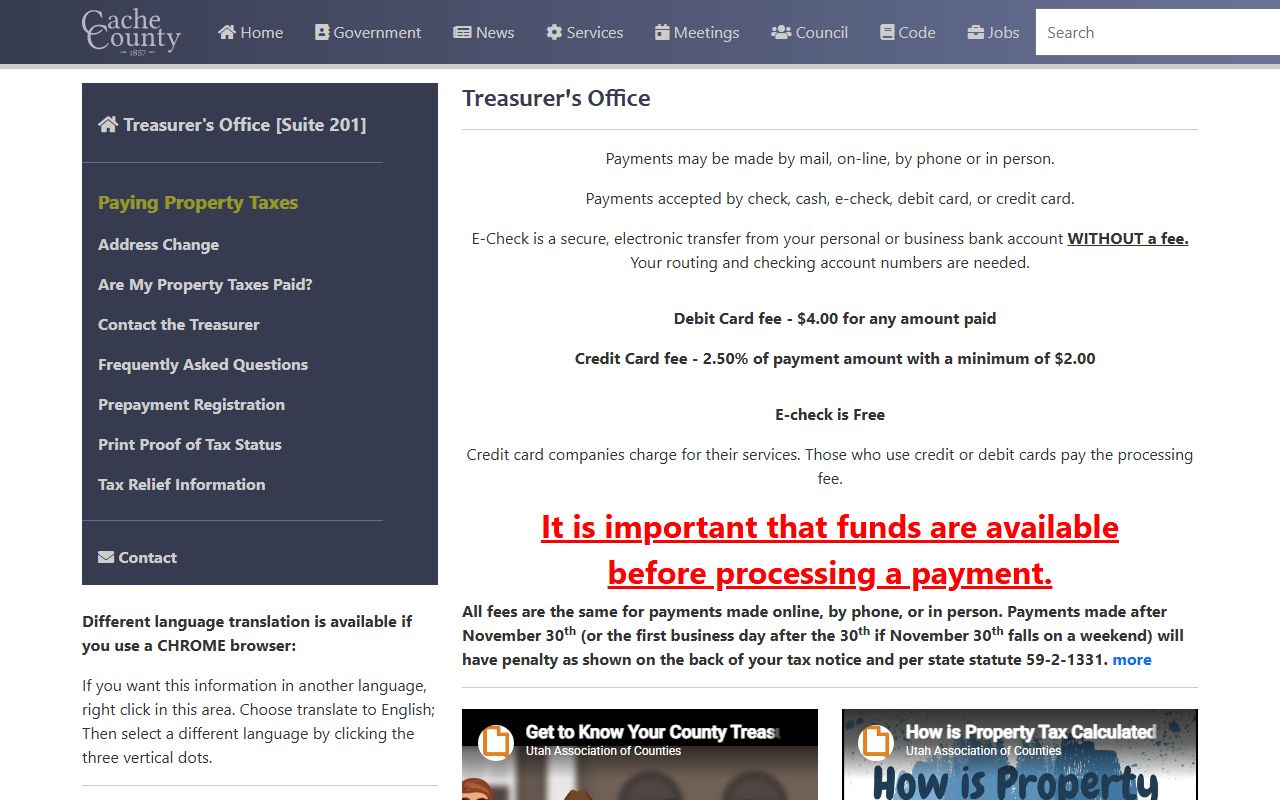
The Cache County Treasurer's portal lets Logan property owners view and pay their tax bill online, confirm prior payments, and check for any delinquent amounts tied to their parcel.
If your Logan property is financed with a mortgage, your lender likely pays taxes through an escrow account. Confirm payment through the treasurer's portal each fall. Escrow estimates are based on the prior year's tax amount, but values and rates can change. A shortfall in escrow means your lender may send a catch-up payment and raise your monthly payment for the coming year. Catching this early avoids surprises.
Delinquent Logan property taxes accrue interest under state law. Property owners who fall behind should contact the Cache County Treasurer's office promptly to understand what they owe and whether any assistance is available. Long-standing delinquencies can lead to tax lien proceedings, which create more complex and costly problems to resolve.
Logan Building Permits and Assessment
Logan's Development Services at loganutah.gov/development handles all zoning, planning, and building permits within city limits. Permits issued by the city are reviewed by the Cache County Assessor to identify improvements that should update the assessment roll. Adding a room, finishing a basement, building a garage, or making major renovations are all examples of work that can trigger an assessment update once the permit closes.
Logan has a significant stock of older housing, particularly near the historic downtown and in neighborhoods that predate modern building codes. When owners renovate these older homes, permit records help the assessor understand the scope of work. If you improve an older Logan property and the assessed value increases notably after the renovation, that update was likely triggered by the permit review. You can verify what data the assessor has on your property through the online parcel viewer and dispute any inaccuracies through the assessor's office.
The Logan 2045 General Plan process also involves zoning updates that may affect how certain Logan parcels are classified. A change from single-family residential to mixed-use or commercial zoning affects both the land value and the potential improvement value on a parcel. Property owners in areas targeted for rezoning should watch for assessment changes in the years following any zoning action.
How to Appeal Your Logan Assessment
Cache County property owners in Logan can appeal their assessed value to the County Board of Equalization. The deadline is printed on your assessment notice. File before that date. The board hears your evidence alongside the assessor's data and issues a ruling. Most Logan residential appeals are handled without legal representation.
Use recent sales of comparable Logan homes to build your case. Look for properties similar to yours that sold for less than your assessed value in the months before January 1. The assessor must value at 100% of market value. If recent sales show a lower market price, that is your strongest evidence. A formal appraisal from a licensed appraiser gives your case more formal weight and is especially useful if your appeal goes to the second level.
If the Cache County Board of Equalization does not grant the reduction you believe is fair, you can appeal to the Utah State Tax Commission at tax.utah.gov/contact/property-tax. Phone 801-297-2200, office at 210 N 1950 W, Salt Lake City, UT 84134. The commission's decision is final except for review in district court. Their process is more structured than the county board but still accessible to Logan property owners without attorneys.
Cache County Recorder and Logan Property Documents
The Cache County Recorder at cachecounty.org/recorder holds all recorded documents for Logan properties. This includes deeds, mortgages, liens, plat maps, and easements. Search the recorder's database online by grantor, grantee, document type, or parcel number. Most documents can be viewed online at no charge. Certified copies require a per-page fee at the office.
The recorder's documents are essential for confirming ownership in Logan. When you buy a property in Logan, the deed must be recorded to notify the assessor of the ownership change and ensure future tax notices come to you. Failure to record a deed on time means the prior owner continues to receive tax notices and you may miss important deadlines. Always record your deed promptly after closing.
Plat maps in the recorder's database show how Logan neighborhoods were originally subdivided. This matters for boundary questions, easement locations, and legal descriptions that tie to the assessor's parcel records. If you have a question about your Logan lot's exact boundaries, the plat map on file with the recorder is the place to start. The Utah property tax rate comparison at propertytax101.org shows Cache County's 0.52% rate is one of the lowest in Utah, making Logan one of the more affordable places in the state for annual property taxes.
Cache County Property Tax Records
Cache County manages all property tax assessment, recording, and collection for Logan. Logan is the county seat, so the assessor, recorder, and treasurer offices are all located within the city, making in-person access straightforward for local property owners.
Nearby Cities
Logan is the only qualifying city in Cache County. Ogden in Weber County is the nearest large city on the Wasatch Front.