
Find Cedar City Property Tax Records
Cedar City property tax records are maintained by Iron County, not by Cedar City itself. The Iron County Assessor values all parcels in Cedar City, and the Iron County Treasurer handles billing and collection. Cedar City is the largest city in Iron County and the county seat, which means the county offices that manage your property records are located right in town. This page explains how to find Cedar City property tax records, how Iron County handles assessment and billing, what exemptions are available, and how to appeal if your value seems wrong.
Cedar City Quick Facts
Iron County Assessor for Cedar City Parcels
The Iron County Assessor is the office that holds Cedar City property tax records. The assessor values all real property in Iron County each year, including every residential, commercial, and vacant parcel in Cedar City. The Iron County Assessor maintains offices in both Cedar City and Parowan, the county seat. Cedar City residents can reach the assessor at the Cedar City office without driving to Parowan.
You can search Cedar City parcels online through the Iron County Assessor's portal. Enter a street address or parcel number to pull up the current assessed value, property class, ownership, legal description, and exemption status. The record shows how the assessor categorizes your Cedar City property and what value has been assigned for the current tax year.
Iron County is a smaller county by population compared to Salt Lake or Utah County. The assessor's office is more accessible and often easier to reach by phone or in person. If you have questions about a Cedar City parcel that the online search does not answer, calling the Cedar City office directly is a practical step.
Note: The Iron County Assessor's two-office structure means you can visit in Cedar City rather than traveling to Parowan. Check the county website for current office hours before visiting.
Cedar City Assessment and Tax Records Online
Iron County's effective property tax rate of 0.51% is below the state average. That rate means Cedar City property owners generally pay less per dollar of assessed value than residents in higher-rate counties. The median annual tax in Iron County is $1,043, based on a median home value of around $204,600. Cedar City homes at or near that value will typically see annual bills in that range.
For tax payment information, use the Iron County Treasurer. The treasurer's office handles billing, payment processing, and delinquency records for all Cedar City parcels. Once you have your parcel serial number from the assessor's database, the treasurer's system shows whether taxes are current and what amount is due. Online payment options are available through the county's website.
Cedar City does not maintain its own property tax database. All records flow through Iron County offices. The city's role in property taxation is limited to providing zoning approvals and issuing building permits, both of which can indirectly affect your assessed value when improvements are made.
The Cedar City official website provides links to city services and local information, with directions to county offices for property tax matters.
Cedar City's city website covers local services, development permits, community events, and links to Iron County property resources for residents searching for tax records.
The Iron County Assessor is the primary source for Cedar City parcel values, ownership records, and exemption status.
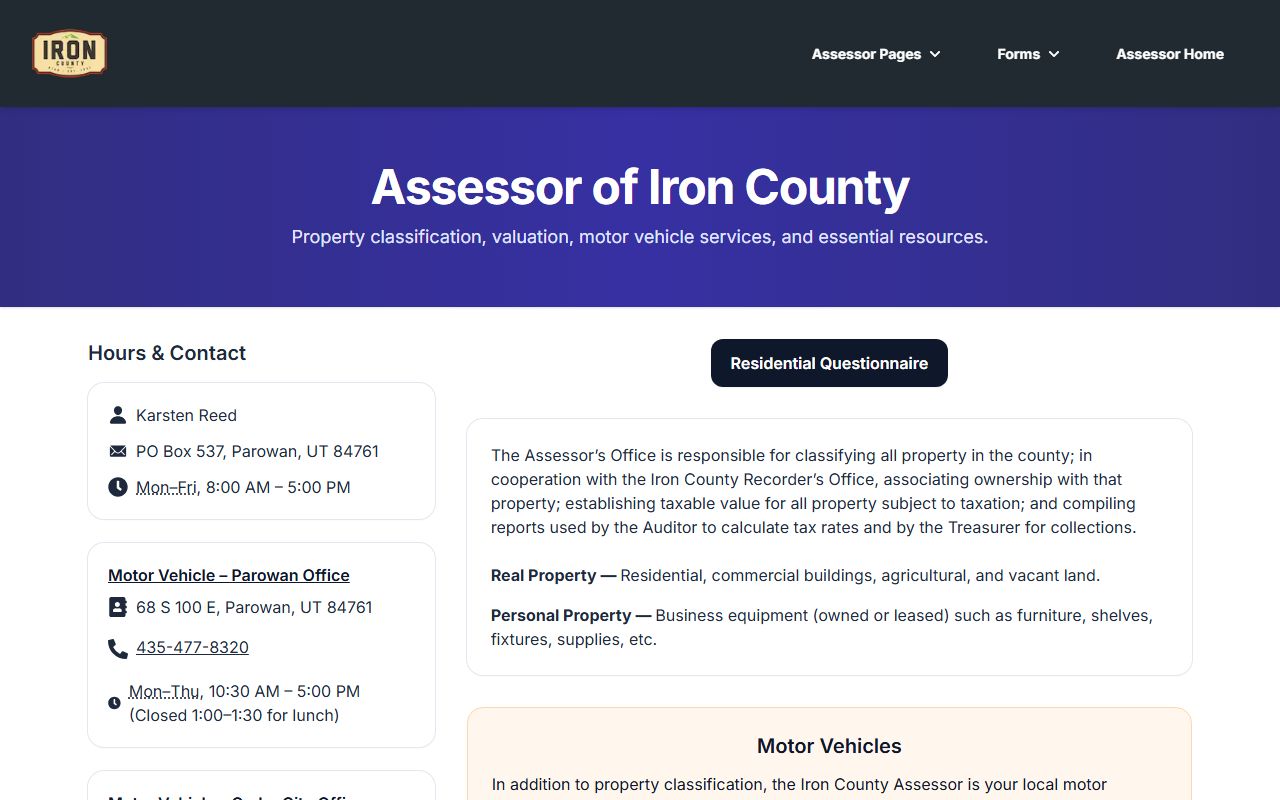
The Iron County Assessor's portal covers all Cedar City parcels. Search by address or parcel number to view current assessed values, property characteristics, and ownership information for any Cedar City property.
For tax billing and payment records on Cedar City parcels, the Iron County Treasurer maintains the collection system.
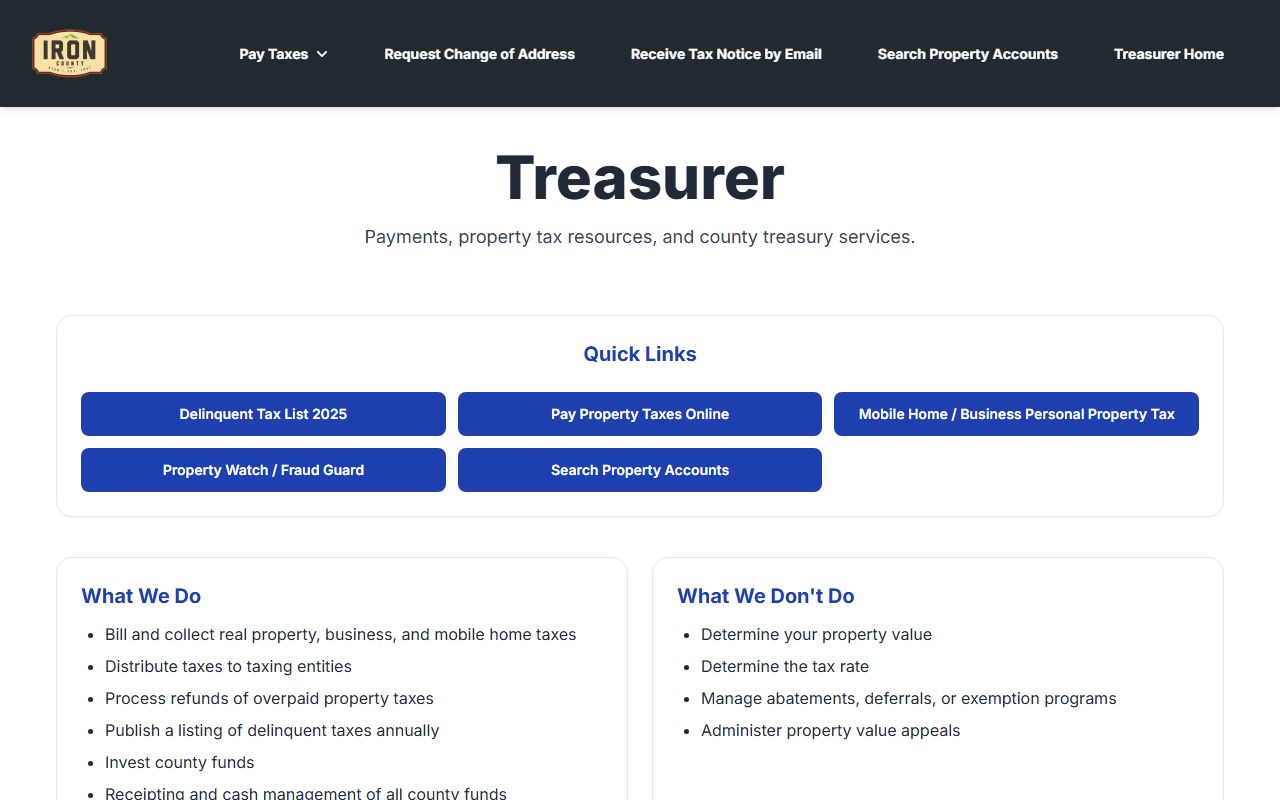
The Iron County Treasurer handles all property tax bills and payments for Cedar City. You can look up whether taxes are current and pay online through the treasurer's portal.
How Cedar City Properties Are Assessed
Under Utah Code Title 59, Chapter 2, all real property in Utah must be assessed at 100% of fair market value as of January 1 each year. The Iron County Assessor applies this rule to every Cedar City parcel. Fair market value is determined by analyzing recent sales of comparable properties, accounting for differences in size, condition, age, and location.
Cedar City is a growing community anchored by Southern Utah University and a strong local economy. The university brings a steady population of students, faculty, and staff, which creates demand for housing in Cedar City and surrounding areas. This demand affects local real estate prices and, in turn, the assessor's value estimates for Cedar City residential properties.
Cedar City's reputation as "Festival City" draws visitors and residents who value the local arts community, including the Utah Shakespeare Festival. These community anchors help maintain property values and keep the Cedar City real estate market relatively active. The Iron County Assessor uses sales within the local market to calibrate values, so Cedar City-specific trends are reflected in the assessments.
Primary Residence Exemption and Cedar City Tax Bills
Utah's 45% primary residence exemption reduces the taxable value of qualifying Cedar City owner-occupied homes to 55% of full market value. This exemption is automatic for properties where the owner lives on site. It does not apply to rental homes, commercial buildings, or vacant parcels. Those property types are taxed on 100% of assessed value.
To confirm the exemption is applied to your Cedar City home, look up your parcel in the Iron County Assessor's database. The property record shows exemption status. If you recently purchased a Cedar City home or changed the use of a property, the assessor's records may not yet reflect the current ownership or occupancy, and it is worth calling the Cedar City office to confirm.
Cedar City's total property tax bill is the sum of rates from several overlapping taxing districts. Iron County, Cedar City, the Iron County School District, and any applicable special service districts each contribute a levy. Iron County's 0.51% effective rate is among the lower rates in Utah, meaning Cedar City property owners tend to pay less than their counterparts in higher-rate counties for comparable home values.
Note: Southern Utah University is a state institution and its campus property is exempt from property taxation. Cedar City's assessed tax base does not include SUU buildings, which affects how total levy amounts are distributed across private property owners.
Cedar City Building Permits and Assessment
Cedar City issues its own building permits through the Cedar City development department. When you pull a permit for a major addition, a new structure, or a significant renovation in Cedar City, that permit is reported to the Iron County Assessor.
The assessor uses permit data to identify properties that may have increased in value due to improvements. A new addition, a finished basement, or a new garage can all result in a reassessment of your Cedar City parcel. The assessor will typically inspect the property after a permit is closed and update the record if the improvement warrants a value change.
Routine repairs and maintenance do not generally trigger reassessment. But significant permitted work that changes the size or character of your Cedar City property should be expected to affect the tax record going forward.
Appealing a Cedar City Property Tax Assessment
Cedar City property owners who disagree with the Iron County Assessor's value can file an appeal with the Iron County Board of Equalization. The deadline is printed on your annual assessment notice and is typically a short window after the notice is mailed. You must file within that window or wait until the next tax year.
Gather evidence before filing. Comparable sales from Cedar City, a licensed appraisal, or documentation of property defects all support a value reduction. Errors in the assessor's data, like incorrect square footage or wrong property type, are strong appeal grounds and are often resolved quickly. Bring the evidence to the Board of Equalization hearing.
If the Iron County Board of Equalization does not rule in your favor, you can escalate to the Utah State Tax Commission Property Tax Division. The Commission holds formal hearings and can require Iron County to revise your Cedar City assessment. The Utah State Tax Commission website also provides general resources on property tax rules and the statewide appeals process.
Iron County Property Tax Records
Cedar City is part of Iron County. Every property tax assessment, deed record, and tax payment for Cedar City parcels runs through Iron County offices. Visit the Iron County property tax records page for full county-level details, office contacts, and additional resources.
Nearby Cities
Cedar City is the only qualifying city in Iron County. The closest major city with its own property tax records page is St. George in Washington County to the south.