
Salt Lake City Property Tax Records
Salt Lake City property tax records are maintained by Salt Lake County and cover every parcel within Utah's capital and largest city. Residents and property owners can search assessment data, view tax payment history, and look up ownership information through county offices online or in person. This guide explains how Salt Lake City property tax records work, where to find them, and what steps to take if you need to appeal your assessed value.
Salt Lake City Quick Facts
Salt Lake County Assessor and City Properties
All property tax records for Salt Lake City are held by the Salt Lake County Assessor. The city does not run its own assessment office. The county assessor values every parcel at 100% fair market value as of January 1 each year, following Utah Code Title 59, Chapter 2. Once values are set, the county applies the applicable levy rates to calculate each tax bill. Salt Lake City property owners pay taxes that fund the city, Salt Lake County, local school districts, and several special service districts at once.
The Salt Lake County Assessor's office is at 2001 S State St, Salt Lake City, UT 84114. You can reach them at 385-468-8300. Their office keeps records on parcel size, building square footage, year built, construction type, and improvements. These details drive the assessed value and the amount owed. If your property data is wrong, the assessor's office can correct it. Fixing an error often leads to a lower assessment. The assessor's website at saltlakecounty.gov/assessor lets you look up any parcel in Salt Lake City by address or parcel number.
The city of Salt Lake City maintains zoning records, building permits, and code enforcement data through its Community Development Department at slc.gov/property. While these records do not set your tax bill directly, they affect how the county classifies your property. A change in use or a major renovation triggers an update to the assessment roll. Permit records from the city are cross-referenced by the county when assessors review properties during their required five-year inspection cycle.
The official Salt Lake City website at slc.gov provides access to city services and property information resources.
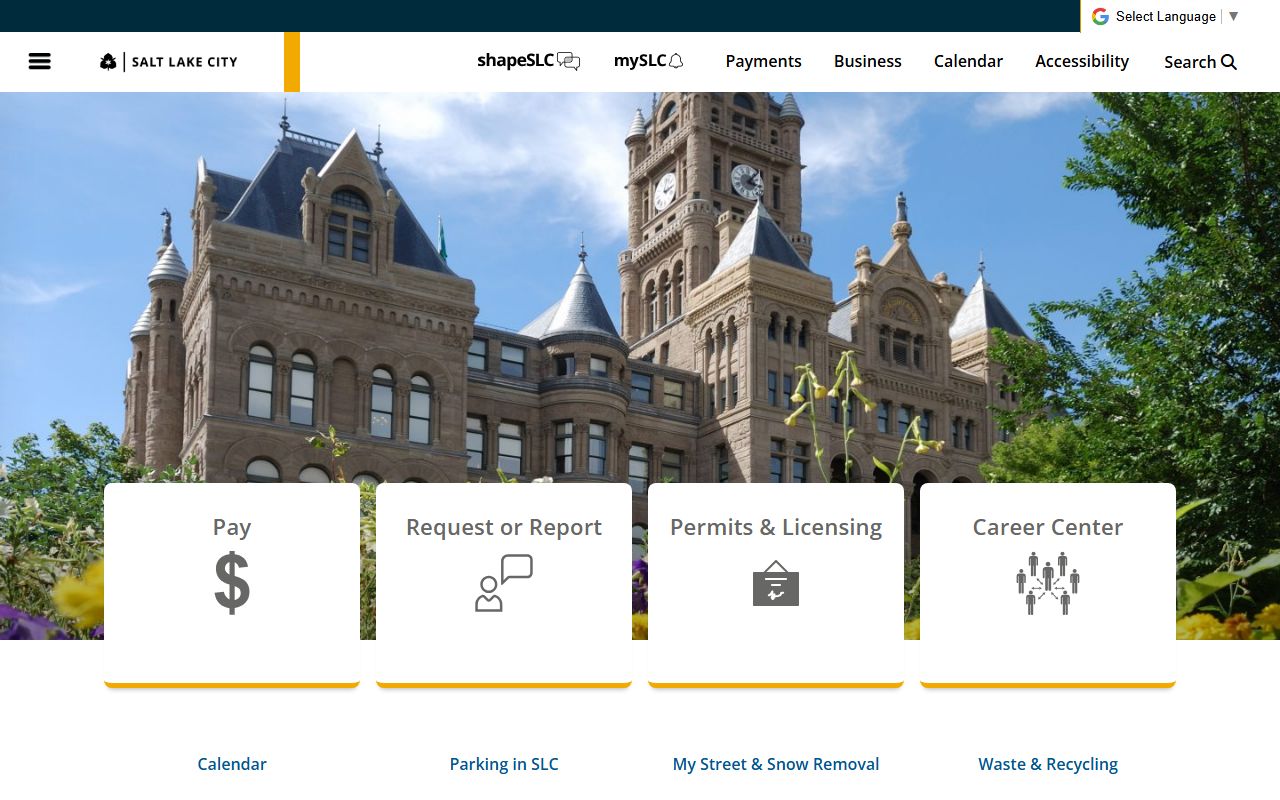
The Salt Lake City portal links to county assessment data, permit history, and zoning information all in one place, making it a useful starting point for property owners researching their records.
How to Find Salt Lake City Property Tax Records
The fastest way to search Salt Lake City property tax records is through the Salt Lake County Assessor's online parcel viewer. Go to apps.saltlakecounty.gov and enter a street address or parcel number. The tool pulls up the full property record including owner name, legal description, land value, improvement value, total assessed value, and taxable value after exemptions. You can also see prior year values and compare them to current ones. Most Salt Lake City searches take under a minute when you have the address ready.
In-person searches are available at the county assessor's office during regular business hours. Staff can search by owner name when you do not have an address or parcel number. Bring a photo ID. Copies of property records are available at the Salt Lake County Recorder's office at 385-468-8145. Copy fees are $2 per page. The recorder maintains deeds, mortgages, liens, and plat maps that connect to each parcel in Salt Lake City.
The Utah GIS portal at gis.utah.gov provides a statewide parcel layer that includes Salt Lake City. This tool is useful when you want to view a property on a map alongside zoning lines, floodplain boundaries, or other spatial data. The GIS layer pulls ownership and value data from county assessor records.
Online Tools for Salt Lake City Property Records
Salt Lake County provides several digital tools for property research in Salt Lake City. The parcel viewer at apps.saltlakecounty.gov/assessor is the primary search portal. It shows current ownership, assessed values by land and improvement, the primary residence exemption if applied, and the full legal description of the lot. You can print or save the results for your records.
The Salt Lake County Treasurer's office at saltlakecounty.gov/treasurer handles tax billing and collection for all Salt Lake City parcels. Their online portal shows what is owed, what has been paid, and whether any delinquent amounts are outstanding. Payments can be made online, by mail, or in person. The treasurer uses the parcel number assigned by the assessor to link assessment records to billing records, so the two databases match.
For deed and document searches, the Salt Lake County Recorder at saltlakecounty.gov/recorder maintains a searchable index of recorded instruments. You can search by grantor, grantee, or document type. Recorded documents show ownership transfers, mortgage filings, lien releases, easements, and subdivisions. These records tie directly into property tax assessment and are important when buying or selling property in Salt Lake City.
Salt Lake City Property Tax Exemptions
Utah law gives primary homeowners a 45% exemption on the assessed value of their main residence. This means Salt Lake City homeowners who live in their property are only taxed on 55% of the full market value. Under Utah Code Title 59, Chapter 2, the exemption is applied automatically when the county classifies a property as a primary residence. If you purchased a home in Salt Lake City and the exemption has not been applied, contact the assessor's office to verify your status.
Other exemptions available in Salt Lake County include agricultural use valuations for qualifying farmland, exemptions for charitable and religious organizations, and partial abatements for low-income elderly or disabled homeowners. The State Tax Commission at tax.utah.gov/contact/property-tax oversees these programs and can direct applicants to the right county office. Applications for most exemption programs have annual deadlines, so do not wait to apply if you think you qualify.
Note: The 45% primary residence exemption does not apply to rental properties, commercial parcels, or vacant land, even if owned by a Salt Lake City resident.
Appealing Your Salt Lake City Property Assessment
Property owners in Salt Lake City have the right to appeal their assessed value if they believe it does not reflect fair market value. The process starts at the county level. When you receive your assessment notice, you have a limited window to file an appeal with the Salt Lake County Board of Equalization. The board hears evidence from both the property owner and the assessor and issues a decision. If you are not satisfied with the board's ruling, you may appeal further to the Utah State Tax Commission at tax.utah.gov.
To build a case for appeal, gather recent sales data for comparable properties in your Salt Lake City neighborhood. The assessor values property at 100% of fair market value as required by state law. If homes similar to yours sold for less than your assessed value, that is strong evidence. You can also hire a licensed appraiser to give an independent opinion of value. Many Salt Lake City property owners who appeal and provide good comps do receive a reduction.
The Utah State Tax Commission's Property Tax Division at tax.utah.gov/contact/property-tax provides training and oversight for county assessors across Utah. The division also hears second-level appeals after the county Board of Equalization. Their office is located at 210 N 1950 W, Salt Lake City, UT 84134, and can be reached at 801-297-2200.
How Salt Lake City Property Tax Rates Are Set
Property tax rates in Salt Lake City are not set by the city alone. Utah uses a system called Truth in Taxation to govern how rates are calculated. Each taxing entity, including Salt Lake City, Salt Lake County, the school district, and various special districts, sets a budget. That budget is divided by the total value of all taxable property to produce a certified tax rate. This keeps the system tied to actual values rather than letting rates drift upward on their own. When property values go up across Salt Lake City, the certified rate often stays flat or drops slightly so that revenues stay level.
If a taxing entity wants to collect more money than the certified rate would generate, it must hold a public hearing and publish notice. This is the Truth in Taxation requirement under Utah Code Title 59, Chapter 2. Salt Lake City residents who want to comment on proposed rate increases have the right to attend these hearings. Dates and times are published in local newspapers and on government websites. This process keeps property taxes in Salt Lake City connected to community input.
Building Permits and Property Data in Salt Lake City
Salt Lake City's Community Development Department at 451 South State Street issues building permits and maintains inspection records. These records matter for property tax because improvements to a home or commercial building must be reported to the assessor. A new addition, garage, or renovation that increases the livable square footage of your Salt Lake City property will raise the assessed value once the permit is closed and the assessor updates their data.
You can search permit history for any address in Salt Lake City through the city's online portal at slc.gov/property. The permit records show work that was approved and completed, including the scope of each project. If you are buying a Salt Lake City property and want to verify that improvements were done with proper permits, this is the place to check. Unpermitted work can create issues during title transfer and may result in a reassessment when discovered by the county.
The city also maintains zoning records, historic landmark designations, and code enforcement history. Historic properties in Salt Lake City may qualify for special valuation treatment under state and local rules. Check with the assessor if you own a historically designated property in the city.
Salt Lake County Property Tax Records
Salt Lake County handles all property tax assessment, billing, and collection for Salt Lake City. The county assessor, treasurer, and recorder offices are the primary sources for property tax records in the city.
Nearby Utah Cities
Other major cities in Salt Lake County and the greater Wasatch Front area also have property tax records maintained by their respective county assessor offices.