
St. George Property Tax Records Search
St. George property tax records are administered entirely by Washington County, which covers all 105,143 parcels in its jurisdiction including every property within city limits. St. George is one of the fastest-growing cities in the entire country, and that rapid growth means new parcels are added to the assessment roll constantly. This guide walks through how to find property tax records for St. George, how the county values properties, what exemptions exist, how rising home values affect your tax bill, and how to appeal if you think your assessment is too high.
St. George Quick Facts
Washington County Assessor and St. George Properties
All property tax records for St. George are maintained by the Washington County Assessor. The city has no assessment function of its own. The assessor values each parcel at 100% of fair market value as of January 1 each year under Utah Code Title 59, Chapter 2. St. George's real estate market has seen sharp appreciation in recent years, drawing retirees, remote workers, and families from across the country. That price growth puts upward pressure on assessed values each cycle.
The Washington County Assessor's office at washingtoncountyutah.gov/assessor is the starting point for all parcel lookups. You can search by owner name, address, or parcel number. Results show land value, improvement value, total assessed value, ownership information, and legal description. Washington County covers a large and geographically diverse area, but the bulk of residential parcels are concentrated in the St. George metro area, making the local data particularly detailed.
St. George's official city website provides building permit records, zoning information, and community development resources that connect to how the county classifies and values property.

The St. George city portal is a useful starting point for permit history and zoning data that feeds into Washington County's assessment process.
How to Find St. George Property Tax Records
The Washington County Assessor's online search is the fastest way to find St. George property tax records. Go to washingtoncountyutah.gov/assessor and search by address or parcel number. The record shows current owner, assessed value broken into land and improvements, exemption status, and taxable value. You can also find the property's legal description and acreage.
For a map-based search, the Washington County GIS portal at washingtoncountyutah.gov/gis lets you click on any parcel in St. George to see its details. This is useful for identifying property lines, viewing neighboring parcels, or checking zoning designations alongside assessment data. The GIS layer is updated regularly and reflects ownership and value data from the assessor's database.
The Utah GIS portal at gis.utah.gov includes a statewide parcel layer covering all of Washington County and is useful for map-based property research.
In-person searches are available at the Washington County offices in St. George. Bring the property address or parcel number for the fastest service. Staff can assist with records that are not yet digitized, older historical documents, or complex searches involving multiple parcels.
St. George Building Permits and Property Values
The St. George Building Department at sgcity.org/building handles permits and code enforcement within city limits. Every permitted improvement in St. George is eventually reviewed by the Washington County Assessor to determine whether the assessed value should be updated. New construction, additions, remodels, and conversions all fall into this category.
St. George has been among the fastest-growing cities in the US for several years running. Developers are active throughout the city, and new subdivisions appear on the assessment roll each year. The rapid pace of construction means the assessor's office stays busy adding new parcels and updating existing ones. If you own a newly built home in St. George, your first full assessment after occupancy will establish the base value for future years.
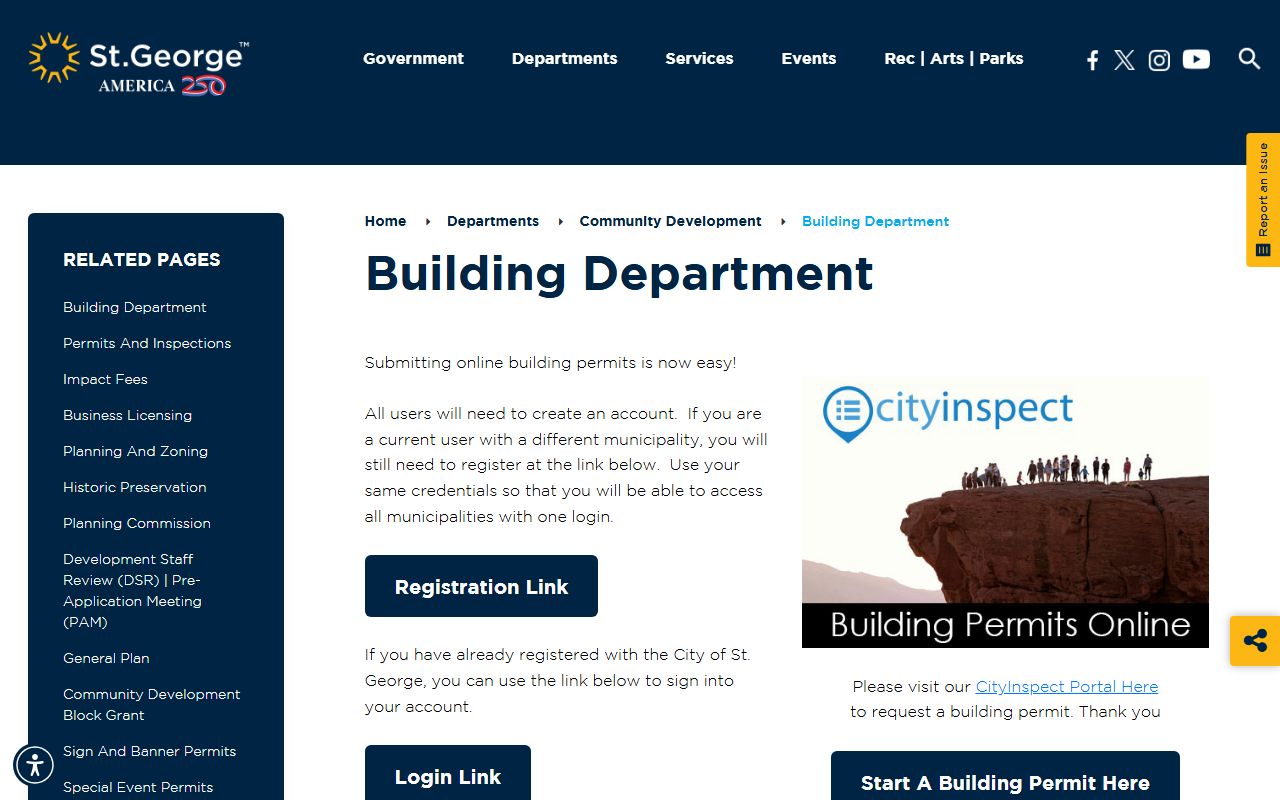
The St. George Building Department portal lets property owners search permit history for any address, which is valuable when evaluating improvements that may affect assessed value.
Note: Unpermitted construction in St. George can still be added to the assessment roll once discovered by the county assessor during a field review.
St. George Property Tax Exemptions
Utah's primary residence exemption gives owner-occupants a 45% reduction in taxable assessed value. If you live in your St. George home as your primary residence, you only pay tax on 55% of its assessed value. This is applied under Utah Code Title 59, Chapter 2 and is the most impactful exemption for most St. George homeowners. The exemption is applied automatically when the property is classified as a primary residence. Rental homes and vacation properties do not qualify.
St. George's growing retiree population may benefit from additional state programs. The Circuit Breaker program provides a partial property tax refund for low-income elderly and disabled homeowners. Applications go through the Utah State Tax Commission by the annual deadline. Qualifying residents of St. George can receive a meaningful reduction in their tax burden through this program.
Agricultural land in Washington County is valued at its productive capacity rather than market value. This matters for any St. George parcels that are used for farming or grazing. The assessor must verify the agricultural use is genuine before applying the reduced valuation. Non-profit and religious organizations also qualify for property tax exemptions under Utah law if their property is used for exempt purposes.
Paying St. George Property Taxes
The Washington County Treasurer at washingtoncountyutah.gov/treasurer collects property taxes for all St. George parcels. Tax notices are mailed in the fall. The full amount is due by November 30. Payments can be made online, by mail, or in person at the county office. The online portal accepts e-check and credit card payments.
Most St. George homeowners with a mortgage have taxes escrowed through their lender. The lender pays the bill from the escrow account and the homeowner does not deal with the county directly. Even so, logging into the treasurer's portal to confirm payment is a good habit. Escrow errors do occur, and the taxpayer is legally responsible for the balance. The treasurer's site shows current amounts due and full payment history by parcel.
Delinquent St. George property taxes accrue interest and penalties under state law. The county has the authority to sell the tax lien on unpaid parcels after a statutory waiting period. Property owners who fall behind should contact the Washington County Treasurer early to discuss their options. Ignoring the issue only adds to what is owed.
Note: St. George property tax bills fund multiple entities at once, including Washington County, the city of St. George, local school districts, and special service districts.
How to Appeal a St. George Assessment
Washington County property owners, including those in St. George, can appeal their assessed value to the County Board of Equalization. The appeal window opens after assessment notices are mailed. You must file before the deadline printed on your notice. Late filings are not accepted.
The strongest appeals compare your assessed value to recent sales of similar St. George properties. The assessor values property at 100% of market value. If similar homes in your neighborhood sold for less than your assessed value in the prior year, that evidence supports a reduction. Sales data is available from the Washington County Recorder, online real estate platforms, and local appraisers. An independent appraisal from a licensed appraiser gives your case more formal weight.
If the Board of Equalization does not provide the relief you need, the next step is the Utah State Tax Commission. Their Property Tax Division at tax.utah.gov/contact/property-tax handles second-level appeals from across Utah. The process is more formal than the county board, but most residential appeals can be handled without legal representation. The commission is at 210 N 1950 W, Salt Lake City, UT 84134, phone 801-297-2200.
Washington County Recorder and Tax Records
The Washington County Recorder at washingtoncountyutah.gov/recorder maintains all recorded documents for St. George properties. This includes warranty deeds, quitclaim deeds, deeds of trust, liens, notices of completion, and plat maps. The recorder's database is searchable online. You can find recorded documents by grantor name, grantee name, parcel number, or document type.
Recorder documents are the legal foundation of property ownership in St. George. When you buy a property, the deed must be recorded for the assessor to update the ownership record and direct future tax notices to you. If a lien is placed on a St. George property, it appears in the recorder's index and ties to the parcel's tax record. Buyers and title companies routinely search the recorder's database before closing to ensure a clean title.
The Utah property tax rate comparison at propertytax101.org shows how Washington County's 0.51% effective rate compares to other counties in the state. Washington County is among the lower-rate counties, which helps offset the appreciation in St. George property values.
Washington County Property Tax Office
Washington County handles all property tax assessment, collection, and recording for St. George. The assessor, treasurer, and recorder offices serve all city residents and can be accessed online or in person at county facilities in the St. George area.
Nearby Cities
Washington City is nearby and also has property tax records managed by Washington County offices.