
Washington County Property Tax Records
Washington County property tax records cover approximately 105,143 parcels managed by the county Assessor, Recorder, and Treasurer offices in St. George, in the southwest corner of Utah near Zion National Park. Washington County is one of the fastest-growing counties in the United States, with a steady flow of retirees, remote workers, and families relocating to the St. George area's warm climate and lower cost of living. If you need assessed values, parcel data, ownership records, or tax payment information for any Washington County property, this page explains the offices and online tools that hold those records. The county's effective rate of 0.51% is below the statewide average, which makes Washington County an attractive area from a property tax standpoint despite recent home value growth.
Washington County Quick Facts
Washington County Assessor Office
The Washington County Assessor's Office determines property values for all taxable real property in the county. The Assessor is responsible for maintaining accurate assessment records on approximately 105,143 parcels, a figure that grows each year as new development adds parcels to the roll. The county's rapid growth makes the Assessor's role particularly demanding since new subdivisions, commercial projects, and multi-family developments are continuously being assessed and added to the roll. You can reach the Assessor's office and search tools at washingtoncountyutah.gov/assessor.
Washington County's parcel data has solid field coverage across key assessment attributes. Owner name data is complete for 92% of parcels. Total parcel value is populated for 89% of the roll. Structure year built is recorded for 70% of parcels that have improvements. Parcel use description is available for 77% of the roll. Latitude and longitude coordinates are available for 100% of parcels. This level of data coverage supports online searches by location, owner, and parcel type. The remaining gaps in fields like year built and use description tend to occur on older or rural parcels where data collection has not yet been updated.
All Washington County properties are assessed at 100% of fair market value as of January 1, consistent with Utah Code Title 59, Chapter 2. The Assessor uses comparable sales data, cost analysis, and income approaches to value different property types. The residential market in Washington County has seen significant appreciation in recent years, which means the Assessor's office must continuously update its sales analysis to keep assessed values current with market conditions. Properties in St. George, Washington City, and the surrounding communities have all experienced value increases that affect the annual assessment roll.
The Utah State Tax Commission's oversight applies to Washington County's Assessor just as it does to all 29 Utah counties. The Commission audits assessment ratios to ensure that assessed values are close to 100% of market value, and it can require corrections if a county's assessments deviate significantly from that standard. The Utah State Tax Commission portal provides the regulatory framework and forms that apply to Washington County property owners.
The Utah property tax rates page shows how Washington County compares to other counties statewide.
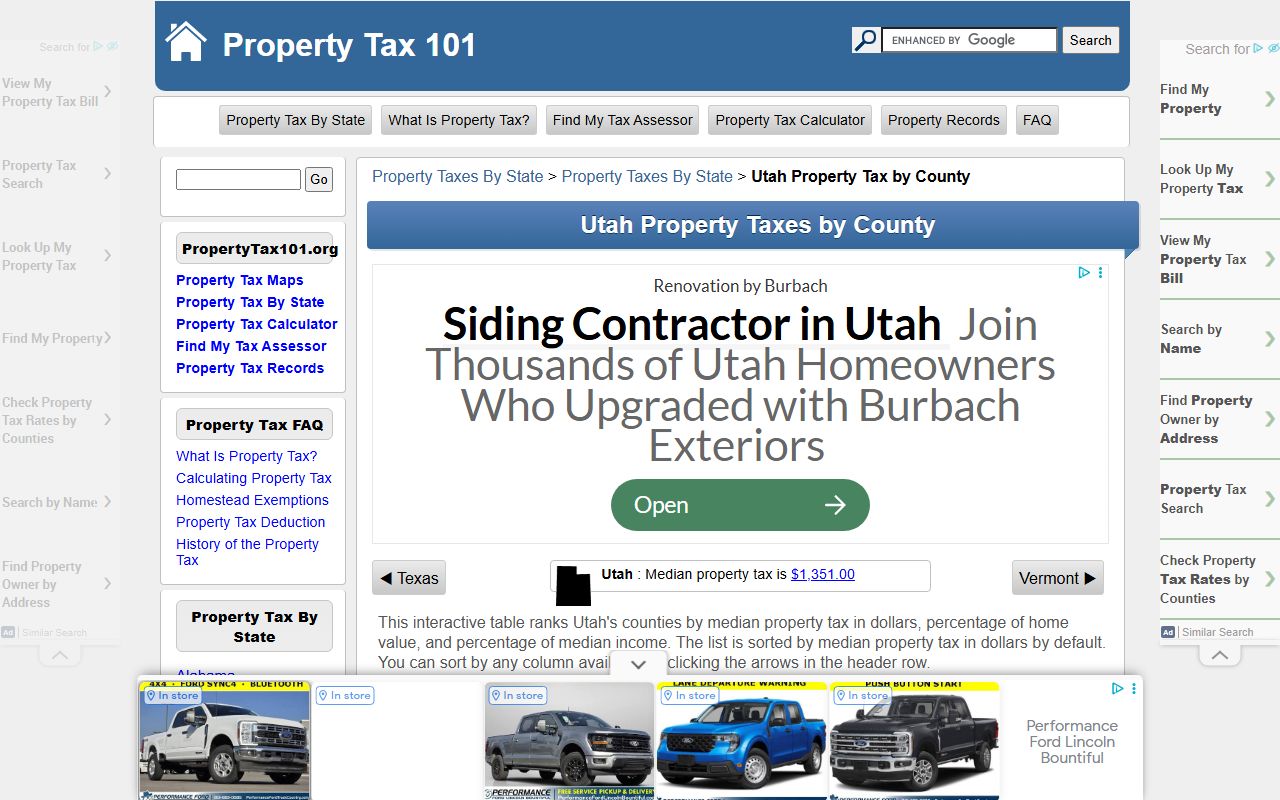
Washington County's 0.51% effective rate is below the Utah average, which reflects a lower combined levy from the county's taxing entities compared to more densely populated counties on the Wasatch Front.
Washington County Recorder Office
The Washington County Recorder maintains all official real property records in the county, including deeds, mortgages, trust deeds, liens, easements, subdivision plats, and condominium declarations. The Recorder's office is the legal repository for all instruments that affect title to real property in Washington County. You can access the Recorder's portal and document search tools at washingtoncountyutah.gov/recorder.
When a deed or other instrument is recorded in Washington County, the Recorder indexes it by grantor name, grantee name, document type, and recording date. This indexing makes it possible to search the chain of title for any parcel by tracing ownership changes through the grantor-grantee index over time. The Recorder also maintains plat maps and subdivision records that show how parcels were divided and named in each development. For new subdivisions added to the roll in recent years, the plat documents filed with the Recorder establish the legal descriptions used on all subsequent deeds and tax records.
Washington County's growth means the Recorder processes a high volume of new instruments each year. Residential sales, refinances, new trust deeds from lenders, and developer-recorded plats for new subdivisions all flow through the Recorder's office. Anyone researching a property's ownership history or looking for recorded liens on a Washington County parcel should start with the Recorder's online index. Copies of recorded documents are available through the portal or in person at the St. George offices.
Note: For very recent recordings, there may be a short lag before new documents appear in the online index. If you need to confirm a same-day recording, contact the Recorder's office directly.
Washington County Treasurer and Tax Payments
The Washington County Treasurer collects property taxes for all parcels in the county and distributes revenues to the taxing entities that serve each property. The Treasurer's portal at washingtoncountyutah.gov/treasurer provides online tools to search tax amounts, view payment history, check delinquent status, and pay current or past-due taxes. Payments can be made online by credit card or e-check, in person at the Treasurer's office, or by mail.
Annual tax notices sent to Washington County property owners list the parcel number and legal description, the assessed and taxable values, the levy rate for each taxing entity covering the parcel, and the total amount due. Taxing entities on a Washington County parcel may include the county government, school districts, the City of St. George or Washington City if the parcel is within city limits, water districts, fire districts, and other special service districts. Parcels in unincorporated areas generally carry fewer taxing entity levies than parcels inside city limits, which can result in a lower total tax bill for rural or semi-rural properties.
Delinquent tax status in Washington County is public record. The Treasurer tracks all overdue accounts, and that information is searchable online. Property taxes in Utah become delinquent after the annual payment deadline, at which point penalties and interest begin to accrue. Properties with taxes delinquent for five or more years may face tax sale proceedings under Utah law. If you find delinquency on a Washington County parcel you are researching, contact the Treasurer's office for a current payoff amount before relying on the amount shown in the online search system, since penalties and interest continue to grow.
Washington County GIS Mapping
The Washington County GIS division provides parcel mapping tools at washingtoncountyutah.gov/gis. The GIS system shows parcel boundaries, ownership information, and property characteristics for the full county. This is a useful tool for anyone who needs to locate a property by address or map coordinates, identify neighboring parcels, or verify parcel boundaries before conducting a transaction or development project.
The GIS parcel layer for Washington County is built from the Recorder's official plat records and linked to the Assessor's tax roll data. This means that a single GIS search can give you both the spatial location of a parcel and its key assessment attributes such as ownership, land area, assessed value, and use code. For Washington County's 105,143 parcels, all of which have latitude and longitude coordinates in the database, the GIS system provides complete spatial coverage. This makes it possible to map any parcel in the county by its coordinates even if a street address is not available.
The Utah GIS Portal also provides statewide parcel data that includes Washington County parcels in a standardized format. This statewide layer is useful for researchers who need to cross county lines or work with parcel data from multiple Utah counties in a single dataset. The Utah GIS Portal is maintained by the State and is separate from the county's own GIS tools, but the two datasets are generally consistent with each other for Washington County parcels.
The Utah GIS portal provides statewide parcel data including Washington County parcels in a format compatible with standard GIS tools.

The Utah GIS Portal's statewide parcel layer covers all Washington County parcels with 100% coordinate coverage, making it a reliable complement to the county's own GIS mapping tools.
How Washington County Property Tax Is Calculated
Washington County property taxes follow the standard Utah calculation. The Assessor sets fair market value as of January 1. For primary residences, that value is multiplied by 55% to get the taxable assessed value, since 45% is exempt under Utah's primary residence exemption. For non-primary-residence properties, 100% of market value is taxable. The combined levy rate from all taxing entities covering your parcel is then applied to the taxable value to produce your annual tax bill.
With a median home value of $240,900, the primary residence exemption reduces the taxable base to roughly $132,495 for a typical Washington County home. At the 0.51% effective rate, the median annual tax comes to $1,231. Washington County's effective rate is below the statewide average, which means property owners in the county pay less per dollar of home value than many other Utah counties. This is one reason the area attracts retirees and others relocating from higher-tax states, since the combination of warm climate and lower property taxes makes it a cost-effective place to own a home.
Vacation and investment properties in Washington County do not qualify for the primary residence exemption. Owners of rental homes, second homes, or investment properties pay taxes on 100% of assessed value. With the county's home values rising steadily, the tax bills on investment properties in Washington County have been increasing as well, even when levy rates remain stable. Truth in Taxation rules still apply, so any taxing entity that wants to collect more total revenue than the prior year must publish notice and hold a public hearing before increasing its levy.
For a statewide comparison of property tax burdens across all 29 Utah counties, the Utah property tax rates by county overview puts Washington County's rate and median tax in context. The broader Utah property tax overview explains how the state system works and how centrally assessed properties factor into county tax rolls.
Appealing a Washington County Assessment
Washington County property owners who disagree with their assessed value can appeal to the Washington County Board of Equalization. You must file your appeal within 45 days of the mailing date on your assessment notice. A written request initiates the process, and the Board schedules a hearing. You present your evidence at the hearing, and the Board issues a ruling. The appeal is at no cost to the property owner.
Comparable sales evidence is the most persuasive tool in a Washington County appeal. If you can show that similar homes in your neighborhood sold for less than your assessed value in the period leading up to January 1, the Board has solid grounds to reduce your assessment. Independent licensed appraisals are also accepted. Data errors in the Assessor's records are another avenue. If the Assessor has wrong square footage, wrong year built, or wrong structural attributes for your parcel, correcting those errors through the Assessor's office may fix the valuation without requiring a full Board hearing. Since the Assessor's parcel database has gaps for some older and rural parcels, it is worth checking your property's data on file before preparing an appeal.
If the Board of Equalization does not resolve your concern, you can escalate to the Utah State Tax Commission Property Tax Division. The Commission hears appeals from taxpayers who have exhausted the county Board process and still believe their assessment is incorrect. For centrally assessed properties like utilities and telecommunications infrastructure in Washington County, the Commission handles appeals directly rather than going through the county Board.
Washington County Property Records and State Resources
Washington County property records are public under Utah's Government Records Access and Management Act (GRAMA). Assessment data, recorded documents, tax billing information, and delinquent tax status are all available to any member of the public. Most of these records are accessible online through the county's Assessor, Recorder, and Treasurer portals. For records not available online, a GRAMA request can be filed at the relevant county office.
The full text of Utah property tax law is at le.utah.gov, and a secondary reference is available through Justia's Utah Code index. Both are useful for understanding the legal framework that governs Washington County property tax records, assessment procedures, and appeals.
The centrally assessed property system at centrallyassessed.utahcounties.org handles utilities, railroads, and other multi-county entities operating in Washington County. These properties are valued by the State Tax Commission and the resulting revenue is allocated to Washington County and other counties where the property operates. Washington County property owners are not directly involved in the centrally assessed system, but the revenue it generates does contribute to the county's overall tax base.
The Utah property tax code at the state legislature is the governing framework for all Washington County assessments, appeals, and exemptions.
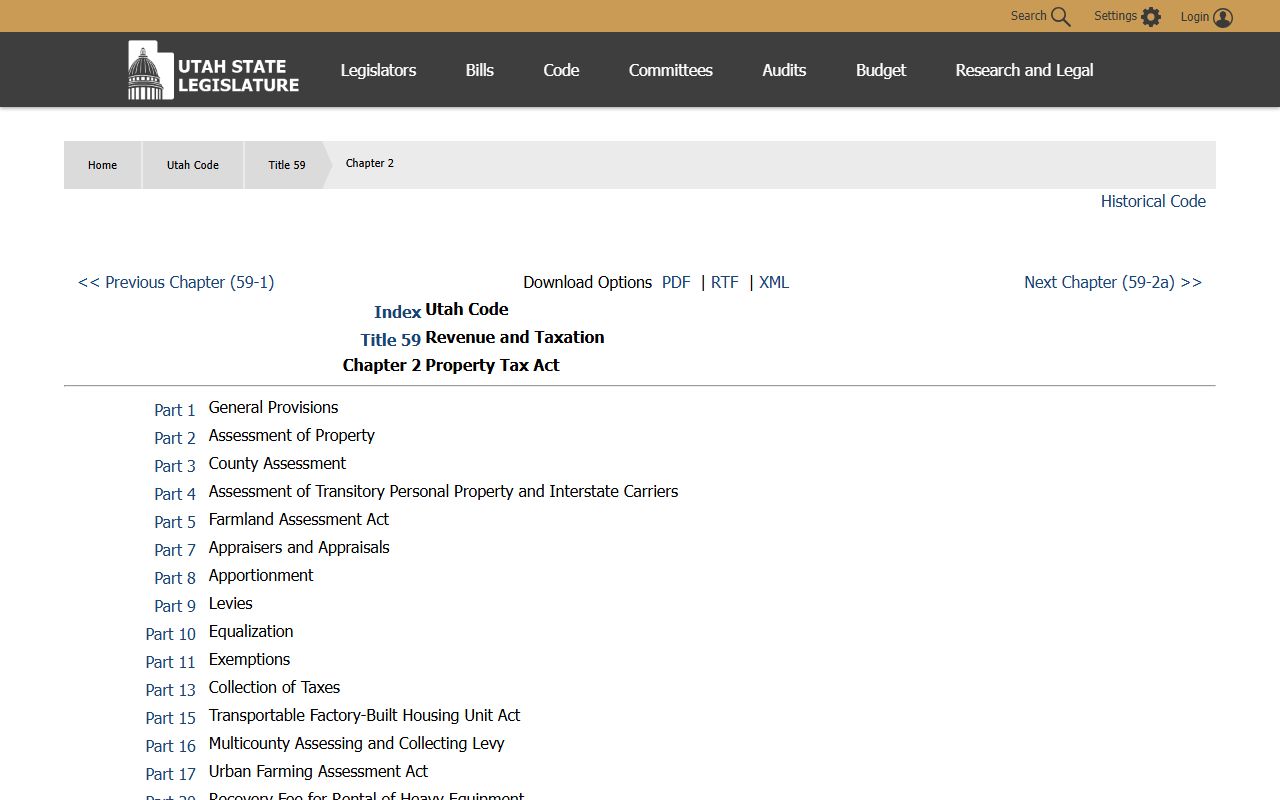
Utah Code Title 59, Chapter 2 governs all aspects of Washington County property taxation including assessment standards, the primary residence exemption, and the appeals process through the Board of Equalization and State Tax Commission.
The Utah State Tax Commission's main portal is the authoritative resource for forms and guidance affecting Washington County property owners.

The State Tax Commission at tax.utah.gov provides oversight of the Washington County Assessor and offers the primary residence exemption application and other tools for Washington County property owners.
Cities in Washington County
Washington County includes two cities with dedicated pages on this site. St. George is the county seat and the largest city in southwestern Utah. Washington is a growing city just west of St. George. Both city pages provide information specific to property tax records in those communities, including courthouse details, local resources, and county office contacts. All Washington County property tax records for properties within either city are maintained by the county offices described on this page.
Nearby Counties
Washington County borders Iron County to the north, Kane County to the east, and Garfield County to the northeast. Each of those counties handles its own property tax records through separate Assessor, Recorder, and Treasurer offices.