
Property Tax Records in Grand County
Grand County property tax records are maintained by the Assessor, Recorder, and Treasurer offices in Moab, Utah. These offices handle property valuations, document recording, and tax collection for all taxable parcels in Grand County. If you need to find assessed values, ownership history, or current tax balances, the county offices in Moab are your primary source for Grand County property tax records.
Grand County Quick Facts
Grand County Assessor Office
The Grand County Assessor values all taxable real property in the county as of January 1 each year. The Assessor maintains property records and conducts periodic field reviews to make sure valuations stay current. Grand County includes Moab and the surrounding rural areas, so the property mix ranges from urban lots and commercial buildings to large tracts of agricultural and recreational land.
Utah property tax law under Title 59, Chapter 2 of the Utah Code requires all property to be assessed at fair market value. Section 59-2-103 defines fair market value as the price a willing buyer and willing seller would agree on without pressure. The Grand County Assessor applies this standard to every parcel in the county. For residential properties, that typically means using comparable sales. For commercial or agricultural land, income and cost approaches may also apply.
Grand County has a median home value of $194,100, which is higher than several neighboring counties. Despite that, the effective tax rate of 0.42% is one of the lower rates in Utah. The median annual tax of $808 reflects both that moderate rate and the primary residence exemption that most homeowners claim. The 45% exemption reduces the taxable portion of a qualifying home to 55% of its assessed value, which keeps bills manageable for owner-occupants in Grand County.
The image below is from the Grand County Assessor's website, which provides access to property records and assessment information for parcels throughout the county.
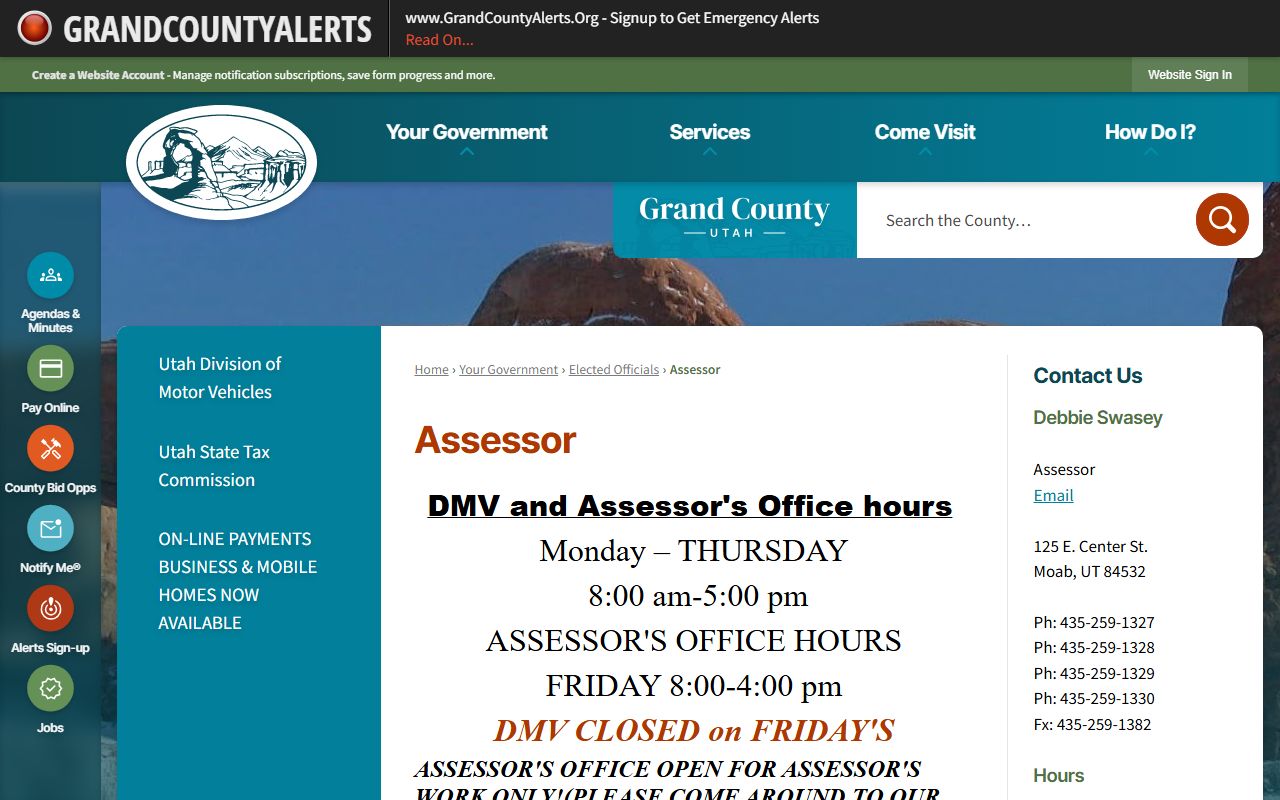
Visit the Assessor's site to look up assessed values and property descriptions for any parcel in Grand County.
Property Tax Records at the Grand County Recorder
The Grand County Recorder maintains all official real property documents for the county. Deeds, mortgages, easements, liens, and other recorded instruments are indexed and available for public inspection. Anyone can view recorded documents at the Recorder's office in Moab. You can search by owner name or parcel number to find all documents associated with a property.
When researching property in Grand County, the Recorder's records tell you who owns a parcel and what encumbrances exist on the title. A deed search reveals every transfer of ownership going back through the record. Trust deeds and reconveyances show the mortgage history. Easements and covenants recorded against a property will appear in the index. Buyers, sellers, title companies, and attorneys all rely on the Recorder's records for due diligence in Grand County real estate transactions.
The image below is from the Grand County Recorder's website, which manages all recorded property instruments for the county.
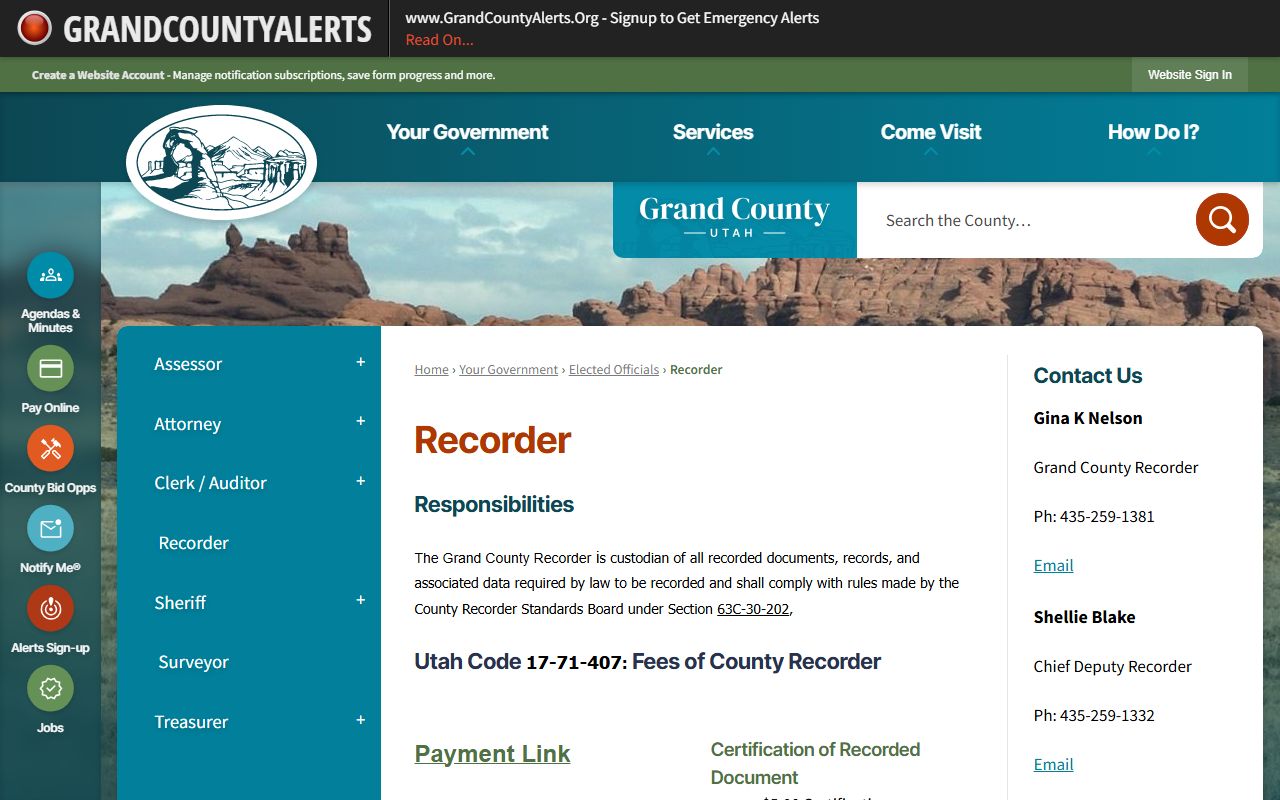
The Recorder in Moab is your source for deed history, lien searches, and all recorded instruments tied to Grand County properties.
Note: Documents recorded with the Grand County Recorder are public records accessible to anyone, not just parties named in the documents.
Grand County Treasurer and Tax Payments
The Grand County Treasurer handles property tax collection and distributes revenues to the taxing entities that serve the county. These include the school district, county government, and various special districts. Property owners in Grand County receive annual tax notices, and the payment deadline is November 30. Payments received after that date are subject to interest and penalties under Utah law.
Before you close on any property in Grand County, it is worth confirming with the Treasurer that taxes are current. A delinquent tax lien runs with the property, not the seller. If you buy land with unpaid taxes, you inherit that obligation. The Treasurer can provide a payoff figure for any delinquent account. Long-term delinquencies can eventually lead to a tax sale under Utah's delinquency statutes. Checking tax status early in the purchase process protects you from unexpected costs.
GIS Mapping and Parcel Data in Grand County
Grand County maintains a GIS system for property mapping. The Grand County GIS portal shows parcel boundaries, ownership data, and basic property information on an interactive map. In a county that spans a large geographic area with diverse terrain, a map-based tool is often the most practical way to locate and identify a parcel before pulling up detailed records.
The Utah GIS portal provides statewide parcel data that includes Grand County properties. This state-level tool draws on county assessor and recorder files and lets you search by address or parcel number. Once you find a parcel on the map, you get the parcel ID number, which you can then use to search the Assessor's records for value data and tax history. Both the county GIS and the state portal are free tools available to anyone.

The Utah GIS portal gives you a map-based view of Grand County parcels without needing to contact a county office first.
How Utah Law Governs Grand County Property Taxes
Grand County operates under the same statewide framework as every other Utah county. The Utah State Tax Commission oversees county assessors and ensures uniform assessment practices statewide. For properties that cross county lines, like utilities, pipelines, and some mining operations, the Commission's Property Tax Division handles valuation directly. The tax revenue from those properties still belongs to the counties where the property is located, including Grand County.
The Utah Code at Section 59-2-102 defines real property to include land, improvements, and minerals or rights that run with the land. It also defines personal property as everything not covered by real property, including business equipment and some mobile structures. These definitions determine how the Grand County Assessor classifies each piece of property for tax purposes. Misclassification can affect how much tax is owed, so it is worth reviewing your property's classification if you believe it is wrong.
For centrally assessed properties in Grand County, owners submit self-reporting affidavits by March 1 each year. Assessment notices go out by May 1. The deadline to appeal a centrally assessed value is August 1. More detail on that process is available through the Utah centrally assessed property portal. For locally assessed parcels, the Board of Equalization in Grand County handles appeals at the county level.
You can compare Grand County's tax rate to other Utah counties using the data at propertytax101.org. At 0.42%, Grand County has one of the lower effective rates in the state, which is notable given its relatively higher median home values compared to rural neighbors.
Appealing Your Grand County Property Tax Assessment
If you think your Grand County property is assessed too high, you have the right to appeal. Start by filing with the Grand County Board of Equalization within 45 days of your assessment notice. At the hearing, present evidence like recent comparable sales in the area, an independent appraisal, or documentation of any condition issues that reduce your property's value. The Board will review the evidence and decide whether to adjust the assessed value.
If the Board denies your appeal or does not lower the value enough, you can take the case to the Utah State Tax Commission Property Tax Division for a second-level review. That process is more formal and may take longer. Most Grand County property owners who appeal at the county level are able to resolve the issue there. The most important thing is to file on time and bring objective market data to your hearing.
Note: The 45-day appeal window from the date on your assessment notice is firm in Utah, so do not delay if you plan to challenge your value in Grand County.
Cities in Grand County
Grand County includes Moab and surrounding communities, but no cities in Grand County meet the population threshold for dedicated city pages on this site.
Nearby Counties
Grand County shares borders with several Utah counties, each maintaining its own property tax records and offices.