
Search Summit County Property Tax Records
Summit County property tax records are maintained by the county Assessor, Recorder, and Treasurer offices in Coalville, Utah. Summit County has the highest median property taxes in Utah, driven by the resort communities of Park City and Deer Valley where home values are among the highest in the state. If you need assessed values, ownership documents, tax balances, or parcel data for any property in Summit County, this page explains which office handles what and how to access the records you need.
Summit County Quick Facts
Summit County Assessor Property Values
The Summit County Assessor is responsible for assessing all taxable property in the county at fair market value as of January 1 each year. Summit County has the highest median property tax in Utah at $1,921 per year. That figure reflects the county's exceptionally high home values. With a median home value of $492,100, Summit County stands far above most of Utah. The effective rate of 0.39% is actually one of the lower rates in the state. The high absolute tax amount is a product of high values, not an unusually high rate.
Park City, Deer Valley, and other resort communities within Summit County drive these numbers. Properties near ski resorts command premium prices, and the Assessor values them accordingly under Utah's fair market value standard in Title 59, Chapter 2 of the Utah Code. The same rules apply here as in every Utah county: properties must be assessed at what a willing buyer would pay a willing seller with full information and no pressure. In a market like Park City, those values are substantial.
For primary residences, the 45% exemption still applies in Summit County. Only 55% of the assessed value is taxable for owner-occupied homes. On a home assessed at $492,100, that brings the taxable value down to about $270,655. The 0.39% effective rate applies to that taxable value, not the full assessed amount. If you own a home in Summit County and it is your primary residence but you have not applied for the exemption, contact the Assessor's office to do so. The savings are significant at these value levels.
Many Summit County property owners are not primary residents. Second homes, vacation rentals, and investment properties do not qualify for the primary residence exemption. These properties are taxed on 100% of their assessed value, which is one reason the effective rate looks low on average. The mix of exempt primary residences and fully taxable vacation properties produces a blended effective rate across the county.
The screenshot below is from the Summit County Assessor's website, where you can search for assessed values and parcel records for properties throughout the county.
The Assessor's page is where you start when you need current assessed values, exemption information, or parcel data for any Summit County property.
Note: The Assessor's office in Coalville handles assessments for all parcels in Summit County, including the high-value properties in Park City and Deer Valley resort areas.
Summit County Property Page Records Search
Summit County provides a dedicated Property Page portal that gives access to property records including deeds, property values, and GIS map links. This is a useful tool if you want a single entry point to multiple types of property information without navigating to each department separately. The portal ties together data from the Assessor, Recorder, and GIS systems into one searchable interface.
Through the Property Page, you can look up a parcel by address or parcel number and get back a summary of the property including its assessed value, ownership information, and links to the GIS map and recorded documents. For buyers, sellers, investors, and professionals doing due diligence on Summit County properties, this portal saves time compared to checking each county office individually.
The Property Page is particularly useful for the high-value residential and commercial properties in Park City, Deer Valley, and the surrounding resort communities. Transaction activity in Summit County is significant, and having quick access to deed history and current values helps parties in a transaction confirm that the records match what is being represented.
The image below shows the Summit County Property Page portal, which is one of the more user-friendly property records tools in Utah.
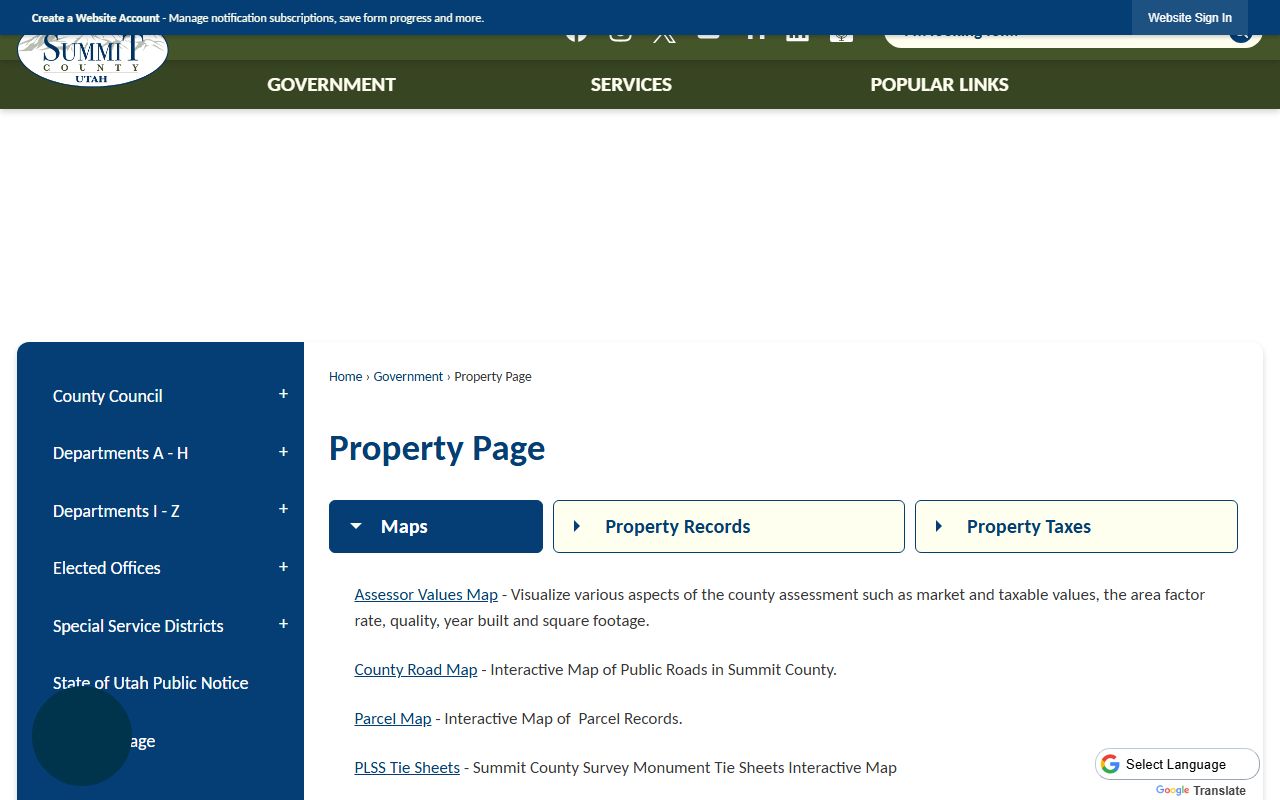
Use the Property Page to access combined records from the Assessor, Recorder, and GIS systems for any parcel in Summit County.
Summit County Recorder and Deed Records
The Summit County Recorder maintains all real property documents filed in the county. Deeds, mortgages, liens, easements, and other instruments must be recorded here to be legally effective. Summit County sees a high volume of real estate transactions given the resort market, so the Recorder's index is active and well-maintained. Title companies and attorneys who work in this market rely on the Recorder's records for every transaction.
When a property sells in Summit County, the deed is recorded with the Recorder's office and the Assessor updates ownership in the assessment roll. This chain of title is what protects buyers from prior claims. For properties in high-turnover markets like Park City, reviewing the full deed history is a standard part of any title search. The Recorder's office in Coalville is the official custodian of these records.
Many Summit County property owners are out-of-state or overseas. The Recorder's records provide a reliable way to identify the legal owner of record regardless of where they live. If you need to contact a property owner for any reason, the most accurate ownership information comes from the most recently recorded deed in the Recorder's index, cross-referenced with the Assessor's current records.
The image below shows the Summit County Recorder's website, where you can access recorded documents and deed records for properties in Coalville and throughout the county.
The Recorder's site is your source for deed history, liens, and other recorded instruments for any Summit County parcel.
Summit County Treasurer Tax Accounts
The Summit County Treasurer collects property taxes and manages tax accounts for all parcels in the county. With a median annual tax of $1,921, Summit County generates more per-parcel tax revenue than any other county in Utah. The Treasurer's office handles billing, payment processing, delinquency tracking, and tax distribution to the various taxing entities that levy on Summit County properties.
Tax notices go out each fall and the full amount is due by November 30. Utah law allows a two-installment option with the first half due November 30 and the second half due May 31 of the following year. Many Summit County property owners, including vacation homeowners and investors, prefer to pay in full. The Treasurer's office accepts payment by mail, in person in Coalville, and through online payment systems if available. Check the Treasurer's website for current payment options.
If you are purchasing a property in Summit County, confirming there are no delinquent taxes is an essential due diligence step. The Treasurer can issue a tax certificate showing the current status of any parcel. Delinquent taxes in Utah carry interest at 1.5% per month, which adds up quickly on high-value Summit County properties. Title insurance typically requires a clean tax certificate before a transaction closes.
The image below is from the Summit County Treasurer's website, where you can check current tax balances and payment status for properties throughout the county.
The Treasurer's site is where you check for outstanding tax balances or make payments on Summit County property accounts.
Note: Delinquent interest in Utah is set by state law and applies uniformly across all 29 counties, including Summit County.
Property Tax Calculation for Summit County
The math behind a Summit County property tax bill starts with the Assessor's fair market value. For a primary residence, 45% of that value is exempt, leaving 55% as the taxable value. For non-primary properties like second homes and rentals, the full 100% of assessed value is taxable. The taxable value is then multiplied by the total levy rate, which is the combined rate of all taxing entities: Summit County general fund, school districts, special service districts, fire districts, and others.
Summit County's effective rate of 0.39% is the blended result across all parcels, including both primary residences and non-primary properties. The rate set by the County Commission and other taxing bodies goes through Utah's Truth in Taxation process each year. If assessed values rise countywide, taxing entities must lower their rates to avoid collecting more money than the prior year without holding public hearings. In a market like Summit County where values have risen sharply in recent years, this process has significant practical effects on rate setting.
You can compare Summit County's rates and values against other Utah counties through PropertyTax101.org's county comparison data. Summit County consistently ranks first in Utah for median annual tax paid and for median home value. The overview of Utah property taxes puts these numbers in statewide context.
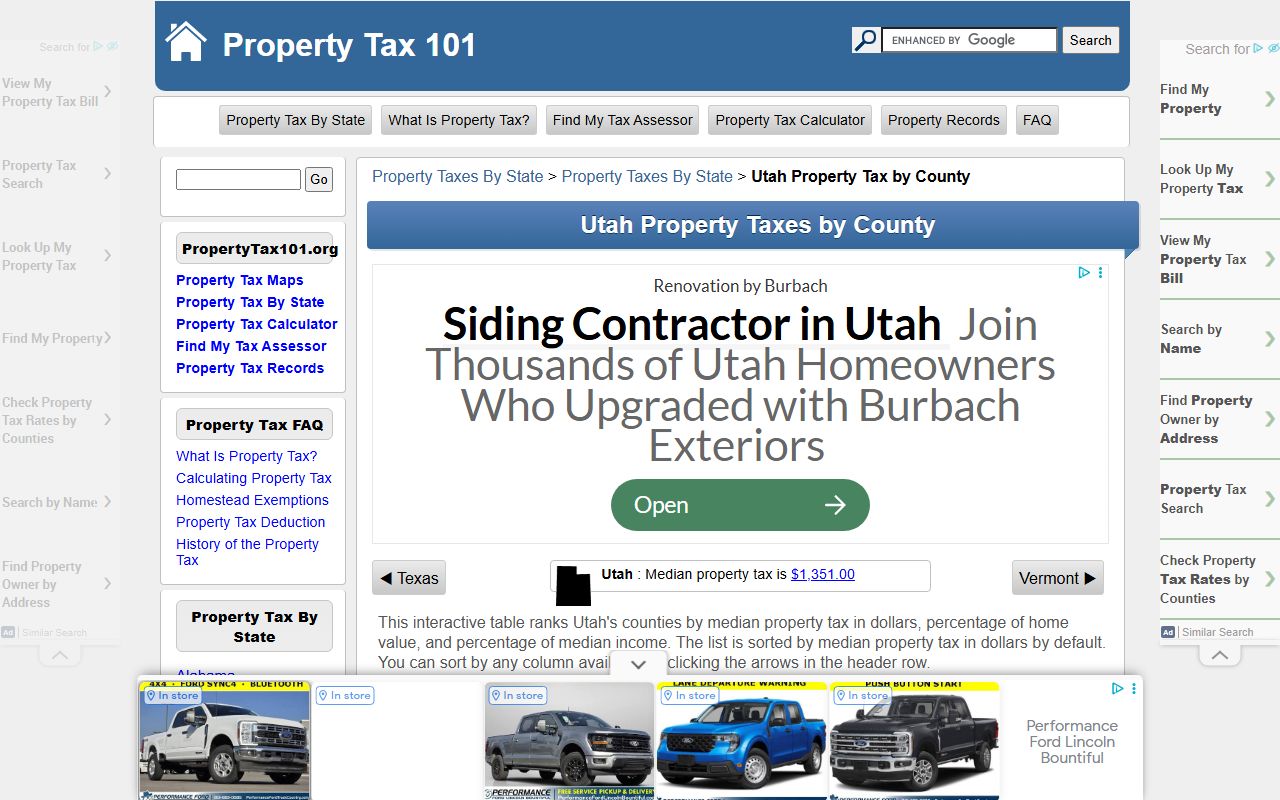
This data shows where Summit County ranks among all Utah counties for property tax rates, values, and median tax amounts.
Summit County Property Tax Appeals
Property owners in Summit County have the right to appeal assessed values they believe are too high. The first step is contacting the Summit County Assessor directly for an informal review. Given the high values in this market, a small percentage change in the assessed value can translate to a meaningful change in your tax bill. Bring evidence of a lower value, such as a licensed appraisal, recent comparable sales, or documentation of property conditions that reduce value.
If the informal review does not resolve the matter, file a formal appeal with the Summit County Board of Equalization before the September 15 deadline shown on your assessment notice. The Board holds hearings and reviews your evidence independently of the Assessor's staff. You present your case, the Assessor presents theirs, and the Board issues a ruling. For high-value Summit County properties, some owners hire professional appraisers or property tax consultants to represent them at this stage.
After the Board of Equalization, appeals can go to the Utah State Tax Commission Property Tax Division. This is the final administrative level before district court. The State Tax Commission has handled numerous appeals from Summit County given the high values and the stakes involved in assessment disputes there. Their process is well-documented on the State Tax Commission website.
Note: In Summit County's resort market, professional appraisers familiar with ski resort property values are important resources for appeal evidence. Standard residential appraisal methods may not fully capture the factors that drive value in a ski-in, ski-out or mountain resort setting.
Online Records Access for Summit County
Summit County offers several online access points for property records. The Property Page portal described earlier is the most integrated option. The Assessor, Recorder, and Treasurer each also maintain their own web presence with direct access to department-specific records.
For GIS mapping and parcel boundary data, the Utah GIS portal provides statewide parcel data that includes Summit County. This is useful for identifying parcel boundaries, neighboring parcels, and geographic context for any Summit County property. The county's own GIS resources are accessible through the Property Page portal.
The full text of Utah's property tax law is at Title 59, Chapter 2 of the Utah Code. This is the statutory framework that governs all assessment and tax collection activity in Summit County. The Utah State Tax Commission provides additional guidance, forms, and contact information for property tax matters throughout the state.
Cities in Summit County
Summit County includes Park City, which is the county's major resort community, but Park City does not have a dedicated city page on this site. The county seat is Coalville. All property tax records for Summit County, including properties in the Park City and Deer Valley resort areas, are administered through the county offices in Coalville described on this page. There are no city-level property tax records separate from the county system for communities within Summit County.
Nearby Counties with Property Tax Records
Summit County borders Salt Lake County to the southwest, Wasatch County to the south, Duchesne County to the east, Daggett County to the northeast, Morgan County to the northwest, and Cache County to the north. Each neighboring county has its own property tax offices and online access tools.