
Find Wasatch County Property Tax Records
Wasatch County property tax records are managed by the county Assessor, Recorder, and Treasurer offices located in Heber City. The county has some of the highest median home values in Utah at $317,900, driven by its proximity to Deer Valley, Park City, and the Wasatch Mountains, yet its 0.47% effective rate is below the state average. If you need assessed values, ownership data, parcel details, or tax payment information for any property in Wasatch County, the offices at 25 North Main Street in Heber City and their online tools are the primary sources. Most records are accessible online without an in-person visit.
Wasatch County Quick Facts
Wasatch County Assessor Office
Bob Adams serves as the Wasatch County Assessor. His current term runs from 2025 to 2028. The office is at 25 North Main Street, Heber City, UT 84032. The phone number is 435-657-3221. The Assessor's stated mission is to assess property professionally and efficiently so that taxing entities can levy property taxes in an equitable way across all property owners in the county. You can reach the Assessor's office and its online tools at wasatchcounty.gov/assessor.
The Assessor is responsible for determining the fair market value of all taxable real property in Wasatch County as of January 1 each year. That includes residential homes, commercial buildings, agricultural land, vacant lots, and other taxable property within the county. Values must reflect actual market conditions, and the Assessor uses recent sales data, cost data, and where applicable, income potential to support those valuations. All properties in Wasatch County are assessed at 100% of fair market value as required by Utah Code Title 59, Chapter 2.
The Assessor's office in Wasatch County offers several distinct services beyond basic valuation. These include the Residential Property Equity Map, which shows assessed values relative to comparable properties in the area, the Primary Residence Exemption application process, Green Belt and Urban Farming Exemption processing for qualifying agricultural land, Business Personal Property assessments for equipment and business-owned assets, Mobile Home assessments, a Property Detail Review Schedule for owners who want to check their property's data, Commercial Property Valuations, and Residential Property Valuations. This range of services reflects the diversity of property types in Wasatch County, from mountain-view residential lots to working farms in the Heber Valley.
The Assessor's portal shows the range of services and resources available to Wasatch County property owners, including the equity map and exemption tools.
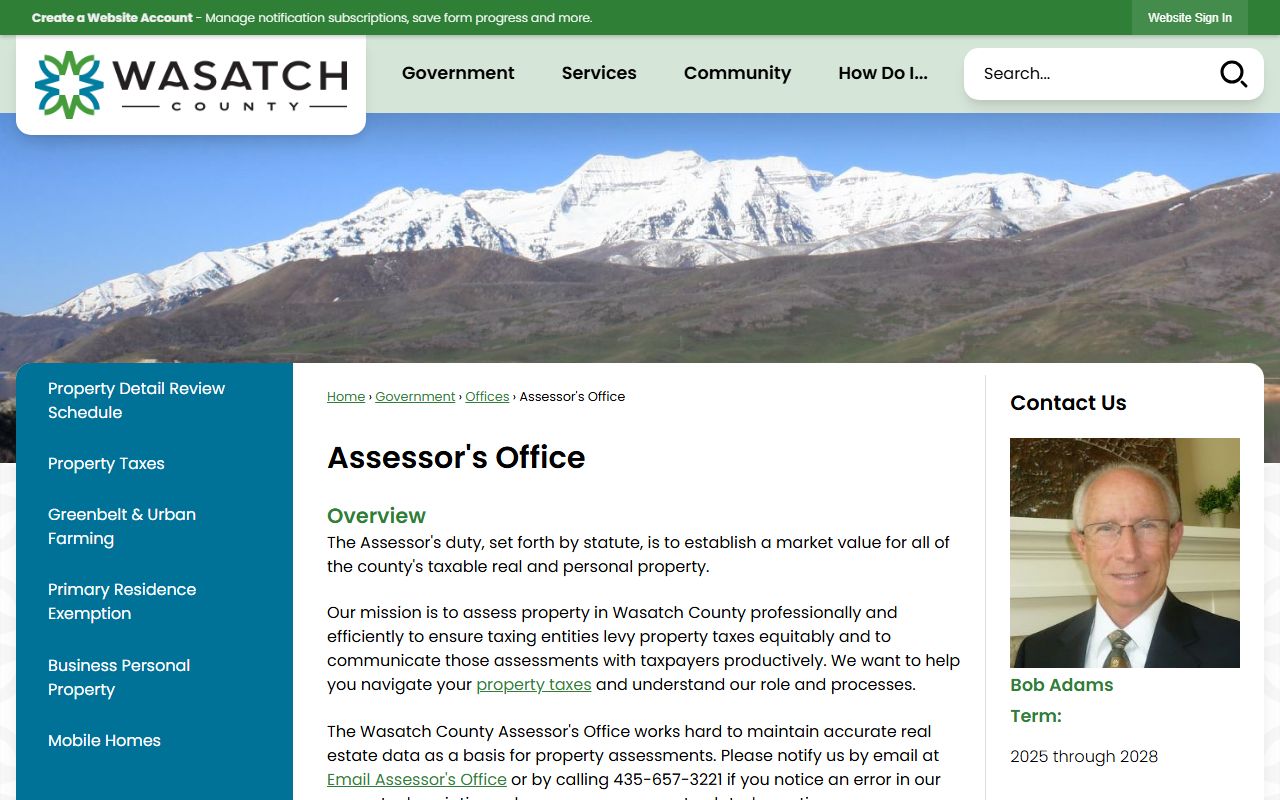
Bob Adams and the Assessor's staff manage valuations for all taxable Wasatch County property and provide the equity mapping and exemption services available through the county's online portal.
Wasatch County Assessment Methods
The Wasatch County Assessor uses three recognized appraisal methods to establish fair market value for different types of property. These are the same methods used by appraisers and assessors across the country, and Utah law requires assessors to consider each approach where applicable. The Assessor's detailed process page at wasatchcounty.gov/assessor-process explains how each method works in practice for Wasatch County properties.
The first method is the sales evaluation approach. This method uses recent sales of comparable properties to estimate what the subject property would sell for on the open market. Assessors analyze data from recent sales in the area and adjust for differences in size, condition, location, and features. In Wasatch County's high-value residential market, sales data from areas like Heber City and the surrounding valley communities are the primary basis for most residential valuations. The Assessor tracks market trends over time using these sales figures to keep assessments aligned with current conditions.
The second method is the cost approach. This method estimates value by calculating what it would cost to replace the existing structure at current prices, then subtracting depreciation for age, wear, and functional obsolescence. The land value is added separately. The cost approach is most reliable for newer properties and specialty buildings where comparable sales are limited. In Wasatch County, newer construction in developing areas may rely more heavily on the cost method until a sufficient body of sales data builds up.
The third method is the income approach. This method estimates value based on the income a property is capable of generating, typically through rental or lease income. It is primarily used for commercial and investment properties. The Assessor converts the income stream to a value estimate using market-derived capitalization rates. Commercial properties in Wasatch County's Heber Valley area, including retail, office, and lodging properties, may be valued using this method.
After the Assessment Roll is complete each year, values are adjusted to apply any applicable exemptions before the roll is forwarded to the County Clerk and Auditor. The Auditor then calculates the Certified Tax Rate for each taxing entity based on the final taxable values. New growth is tracked separately from existing property value changes, which is required under Utah's Truth in Taxation process.
Note: Property owners who believe the Assessor used the wrong method or wrong data for their property should request a Property Detail Review through the Assessor's office before filing a formal appeal.
Wasatch County Recorder Office
The Wasatch County Recorder maintains all official real property records in the county, including deeds, mortgages, trust deeds, liens, easements, plats, and other instruments that affect title. The Recorder's office is located at 25 North Main Street in Heber City, along with the other county offices. The main portal for the Recorder is wasatchcounty.gov/recorder.
Recorded documents in Wasatch County are searchable by grantor name, grantee name, document type, and recording date. When a deed is recorded, the Recorder notifies the Assessor's office so that ownership on the tax roll can be updated. This keeps the assessment records and the recorded document index synchronized. If you find a recent deed in the Recorder's system but the Assessor still shows the old owner, allow a few weeks for the update to process through.
The Recorder's office is the source for plat maps and subdivision records, which show how parcels within a development were divided and named. For any parcel in a platted subdivision, the original plat document filed with the Recorder gives the legal description used on all subsequent deeds and tax documents. Copies of recorded documents are available through the Recorder's online portal or in person at the office.
The Recorder's portal at wasatchcounty.gov/recorder provides online access to recorded property documents for Wasatch County.
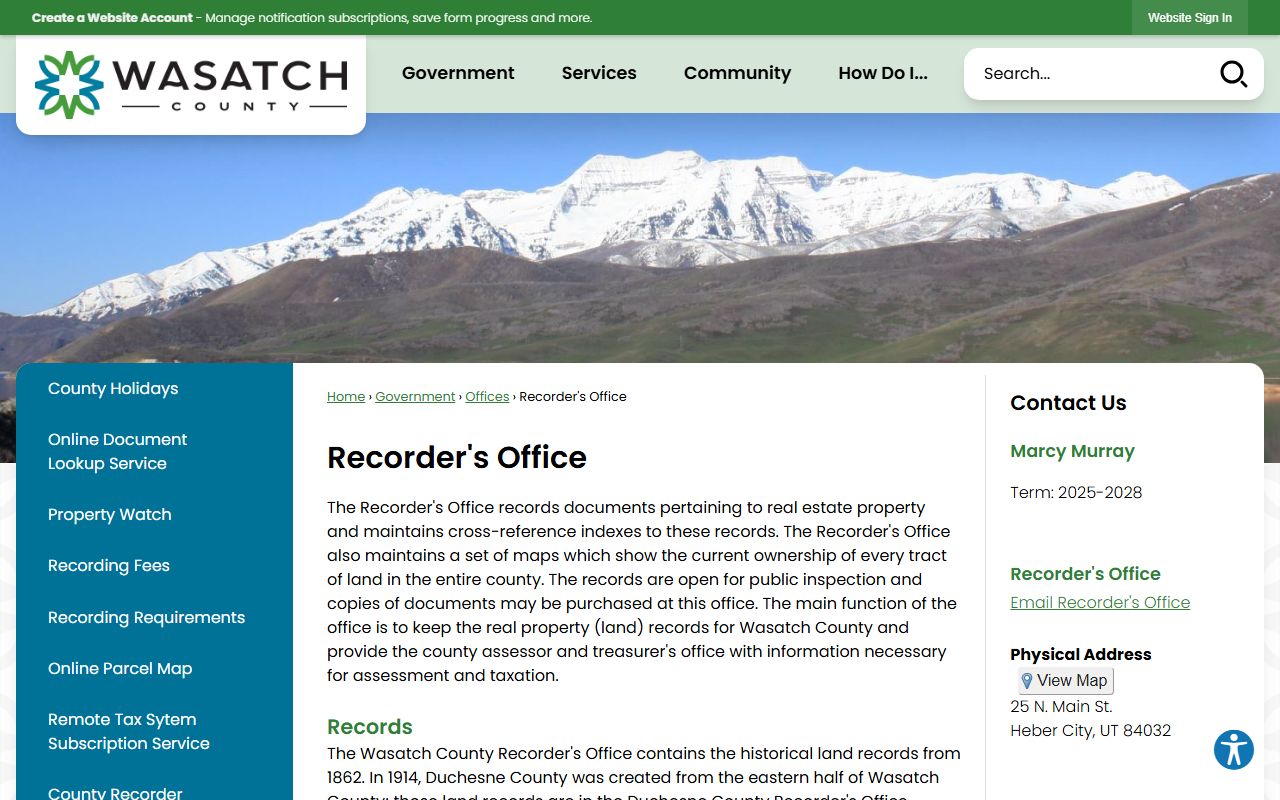
The Recorder's office at 25 North Main Street maintains all instruments affecting real property title in Wasatch County and provides online document search tools.
Wasatch County Treasurer and Property Taxes
The Wasatch County Treasurer collects property taxes billed to all Wasatch County parcels and distributes the revenue to the taxing entities that serve each property. The Treasurer's portal at wasatchcounty.gov/treasurer provides online tax search and payment tools for property owners and researchers. You can look up tax amounts, view payment history, and check whether taxes are current or delinquent for any parcel in the county.
Annual tax notices in Wasatch County list the parcel number, the assessed and taxable values, the levy rate for each taxing entity covering that parcel, and the total amount due. Taxing entities may include Wasatch County government, school districts, Heber City if applicable, water districts, fire districts, and other special service districts. The total number of entities layered on a given parcel depends on its location. Properties near Heber City may carry more service district levies than rural parcels in the unincorporated parts of the county.
Wasatch County property taxes become delinquent after the annual payment deadline. Penalties and interest accrue on unpaid balances. Properties with taxes delinquent for five or more years may be subject to tax sale proceedings under Utah law. Delinquent tax status is public record and can be checked through the Treasurer's portal or the county's online search tools. If you are researching a Wasatch County property and find a delinquency, contact the Treasurer's office for a current payoff amount.
The Treasurer's portal shows payment tools and tax billing information for Wasatch County property owners.
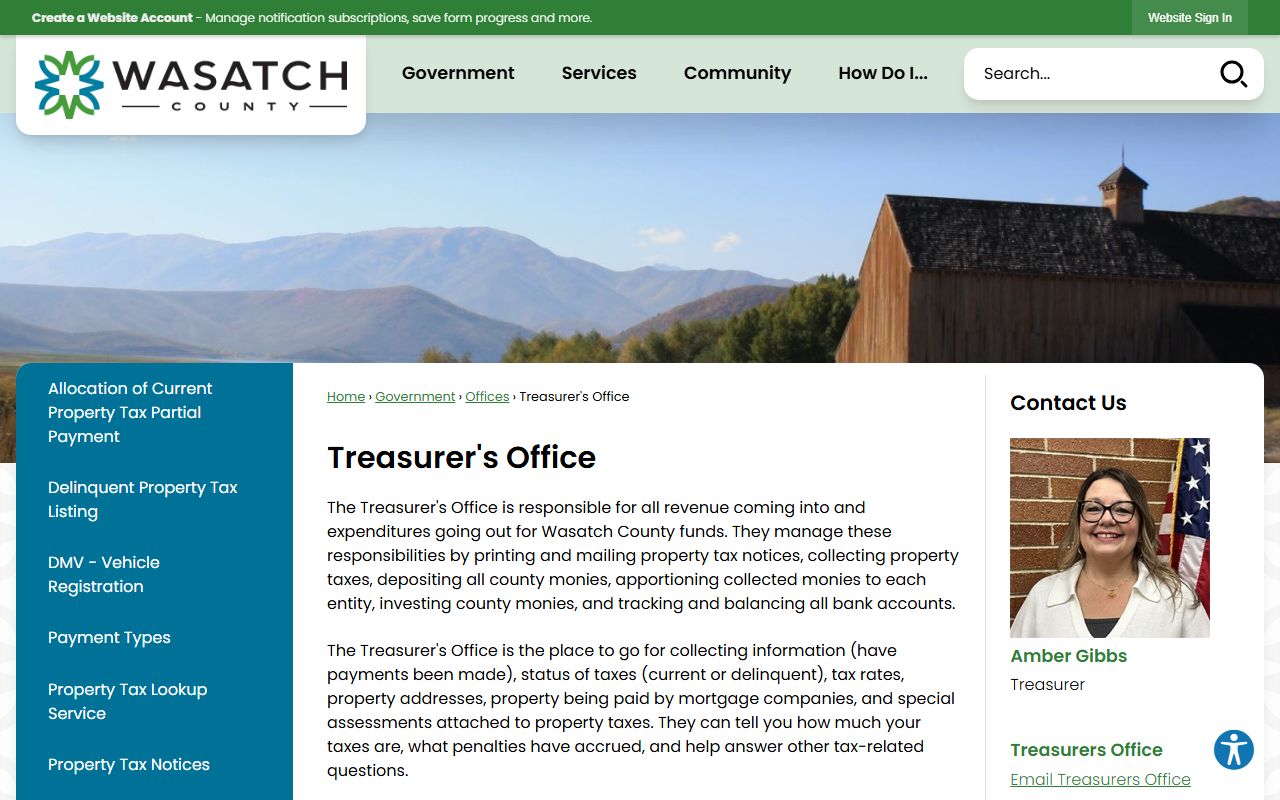
The Treasurer at 25 North Main Street collects all Wasatch County property taxes and maintains delinquency records that are publicly accessible online.
How Wasatch County Property Tax Is Calculated
Wasatch County property taxes follow the standard Utah three-step calculation. First, the Assessor sets the market value of your property as of January 1. Second, that value is multiplied by 55% to get the taxable assessed value, since 45% is exempt for primary residences under Utah law. Third, the combined levy rate from all taxing districts covering your parcel is applied to the taxable value to produce the tax bill. Non-primary-residence properties, like investment homes or vacation cabins, do not qualify for the 45% exemption and are taxed on 100% of market value.
Wasatch County's 0.47% effective rate is one of the lower rates in Utah, which is notable given the county's high median home value of $317,900. That lower rate exists partly because Wasatch County has fewer densely layered taxing entities than urban counties, and partly because a significant share of the county's assessed value comes from high-value properties that carry the same levy rates as more modestly priced homes. The median annual tax of $1,487 reflects this dynamic. A home at the median value pays less than $1,500 per year despite being worth over $300,000, because the 45% exemption and the relatively low rate combine to keep the bill manageable.
Vacation properties and second homes in Wasatch County do not qualify for the primary residence exemption. Owners of ski cabins, mountain retreats, or seasonal properties in the county pay taxes on 100% of assessed value at the same levy rates applied to primary residences. This is worth knowing for anyone comparing a Wasatch County vacation property tax bill to a primary residence tax bill on a similar-value home. The difference in taxable value percentage is significant. For statewide comparison data, see Utah property tax rates by county.
Wasatch County's Green Belt and Urban Farming Exemption is available for qualifying agricultural properties in the Heber Valley. Under this exemption, land actively used for farming or grazing is assessed based on its agricultural use value rather than its market value. In a county where land values have risen sharply due to resort and recreational demand, the Green Belt exemption can mean a very large difference in the assessed value of a qualifying farm parcel compared to what that land would sell for on the open market. Owners interested in this exemption should contact the Assessor's office to apply.
Appealing a Wasatch County Assessment
Property owners who believe the Wasatch County Assessor has overvalued their property can appeal through the Wasatch County Board of Equalization. The County Auditor hears property valuation appeals with the Board of Equalization. You must file your appeal within 45 days of the mailing date shown on your assessment notice. A written request to the Board initiates the process, and the Board will schedule a hearing where you can present your evidence and argument.
The best evidence for a Wasatch County appeal is recent comparable sales data showing that similar properties in your area sold for less than your assessed value. If you have had the property appraised by a licensed appraiser, that appraisal report can serve as independent evidence of market value. You can also raise data errors in the Assessor's records for your parcel. The Assessor's Property Detail Review Schedule exists specifically to let owners check the data the Assessor has on file. If the square footage, year built, room count, or condition data are wrong, fixing those errors may lower the value without requiring a full Board hearing.
If the Board rules against your appeal, you can escalate to the Utah State Tax Commission Property Tax Division, which hears formal appeals from taxpayers who disagree with county Board decisions. The Commission's review is a more formal legal proceeding. Most taxpayers find the Board of Equalization level sufficient to resolve reasonable disputes. The State Tax Commission also oversees Wasatch County's Assessor to ensure assessments are uniform and equitable across property classes.
Utah State Resources for Wasatch County Owners
The Utah State Tax Commission oversees all county assessors including Wasatch County, and its website provides forms, guides, and appeal information relevant to all Utah property owners. The Primary Residence Exemption application, which claims the 45% reduction in taxable value, is available through the State Tax Commission's site. Property owners must file this application when they first purchase a home or when they change their primary residence designation. It does not renew automatically in all cases.
The centrally assessed property program handles utilities, railroads, and other multi-county entities whose values are set by the State Tax Commission rather than individual county assessors. Wasatch County receives an allocation of revenue from these centrally assessed properties. The Utah GIS Portal also provides statewide parcel data that includes Wasatch County parcels for those who need bulk property data in GIS format.
For a plain-language look at the legal framework governing Wasatch County property taxes, the full Utah property tax code is available at le.utah.gov. The code covers assessment standards, exemption rules, appeal procedures, and tax sale requirements that apply uniformly across all 29 Utah counties including Wasatch County.
The Utah State Tax Commission's main site provides oversight and resources for Wasatch County property owners dealing with assessment or exemption questions.

The State Tax Commission at tax.utah.gov is the authoritative source for Utah property tax forms, exemption applications, and appeal information that applies to all Wasatch County property owners.
The Utah property tax division page at the State Tax Commission is the contact point for formal appeals after the county Board of Equalization process.
The Property Tax Division at the State Tax Commission hears appeals from Wasatch County property owners who have gone through the county Board of Equalization and still disagree with their assessed value.
Cities in Wasatch County
Heber City is the county seat and largest city in Wasatch County. No cities in Wasatch County meet the population threshold for a dedicated city page on this site. Property owners and researchers in Heber City and other Wasatch County communities should use the county offices and online tools described on this page. All property tax records for properties within Heber City are maintained by the Wasatch County Assessor, Recorder, and Treasurer at 25 North Main Street.
Nearby Counties
Wasatch County shares borders with Utah County to the southwest, Salt Lake County to the west, Summit County to the north, and Duchesne County to the east. Each neighboring county has its own Assessor, Recorder, and Treasurer handling property tax records for parcels within that county's boundaries.