
Duchesne County Property Tax Records
Duchesne County property tax records are maintained by the county Assessor, Recorder, and Treasurer offices in Duchesne, Utah. These records cover residential, commercial, agricultural, and oil and gas parcels across the county. If you need to find assessed values, tax bills, or ownership details, the county offices and online tools give you a solid starting point for your search.
Duchesne County Quick Facts
Duchesne County Assessor Office
The Duchesne County Assessor determines the taxable value of all real property in the county. Properties are assessed at fair market value as of January 1 each year. That date is the lien date. Whatever the market says a property is worth on that day is what drives the tax bill for that year. The Assessor maintains records on residential, commercial, agricultural, and oil and gas properties throughout Duchesne County.
Utah law under Utah Code Title 59, Chapter 2 defines fair market value as the amount at which property would change hands between a willing buyer and seller when neither is under pressure to act. The Assessor uses this standard when setting values for every parcel in Duchesne County. Under Section 59-2-103, the assessed value must reflect fair market value for all property that is not centrally assessed by the state.
Duchesne County has significant mineral production. Oil and gas properties are assessed by the Utah State Tax Commission rather than the local assessor. The tax dollars still flow to Duchesne County, but the valuation work happens at the state level through the Property Tax Division. This is common in counties with active energy production in Utah.
The screenshot below is from the Duchesne County Assessor website, which is your first stop for parcel-level property tax records in the county.
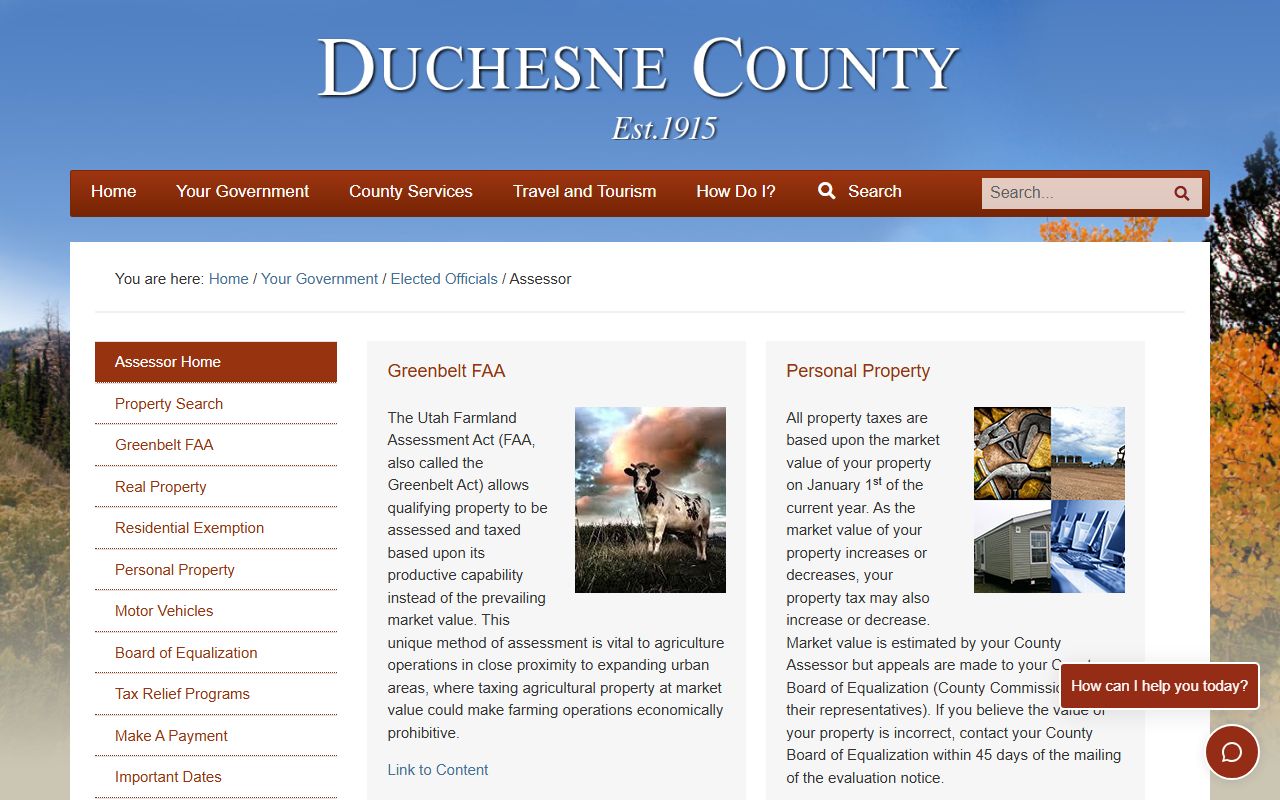
Visit the Assessor's office in Duchesne or use the online portal to look up assessed values for any parcel in Duchesne County.
Property Tax Records at the Duchesne County Recorder
The Duchesne County Recorder keeps all real property records including deeds, mortgages, and other documents that affect ownership. These records are public and available for inspection. When you search for property in Duchesne County, the Recorder's files tell you who owns a parcel and what liens or encumbrances exist against it.
Recorded deeds show the chain of title for every piece of land in Duchesne County. Lenders record trust deeds when a property has a mortgage. The Recorder indexes these documents so anyone can search by owner name or parcel number. If you are buying or selling property, or just trying to verify ownership, the Recorder is the right office to contact.
The image below is from the Duchesne County Recorder's website, which provides access to property documents and recorded instruments.
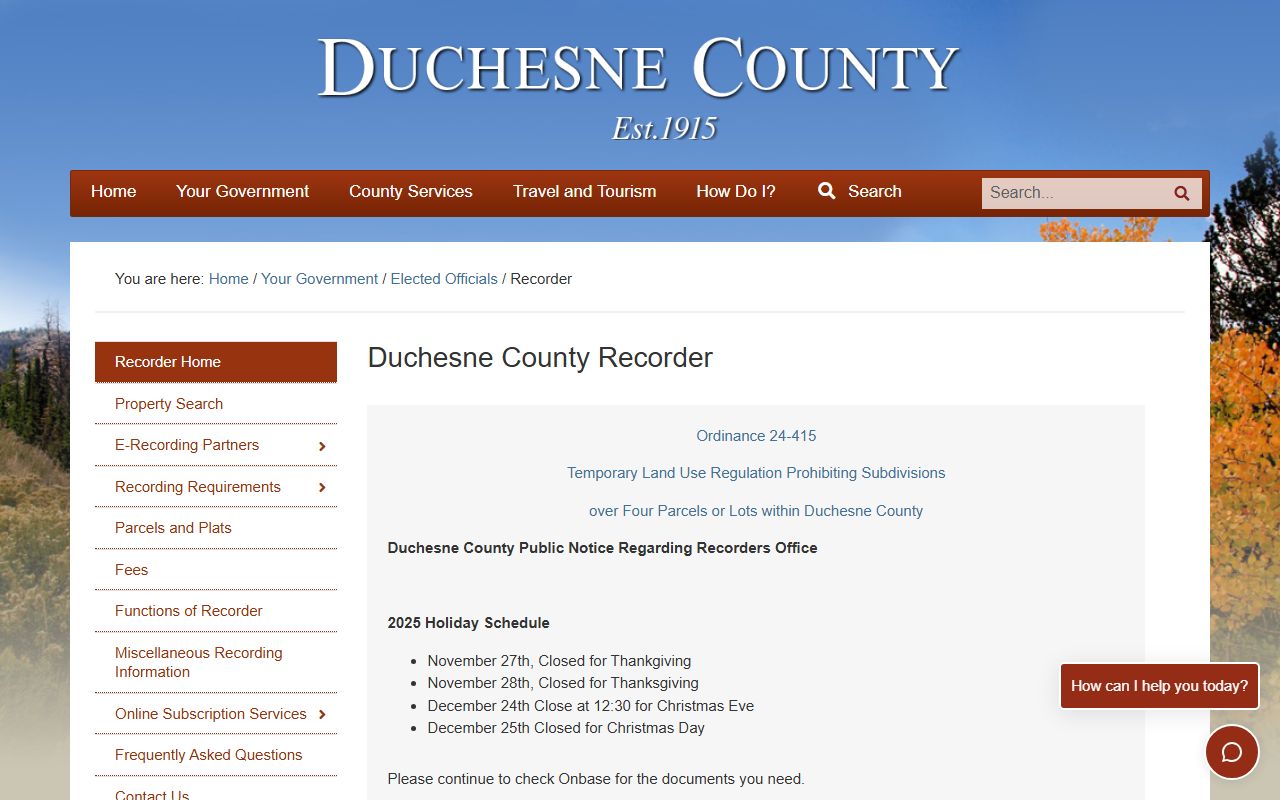
The Recorder's office in Duchesne serves as the official source for all property transaction documents in the county.
Paying Taxes: Duchesne County Treasurer
The Duchesne County Treasurer collects property taxes and distributes them to the various taxing entities that serve the county. These include school districts, fire districts, water districts, and the county government itself. Tax notices go out annually, and property owners in Duchesne County have until November 30 to pay without penalty.
If you want to know whether taxes are current on a property in Duchesne County, contact the Treasurer's office. They can tell you the current balance, show past payments, and confirm any delinquencies. Delinquent taxes accrue interest and penalties under Utah law, and properties with unpaid taxes can eventually be subject to a tax sale. Knowing the tax status of a parcel before you buy is essential.
Note: Property tax payments in Duchesne County are due by November 30 each year to avoid late charges.
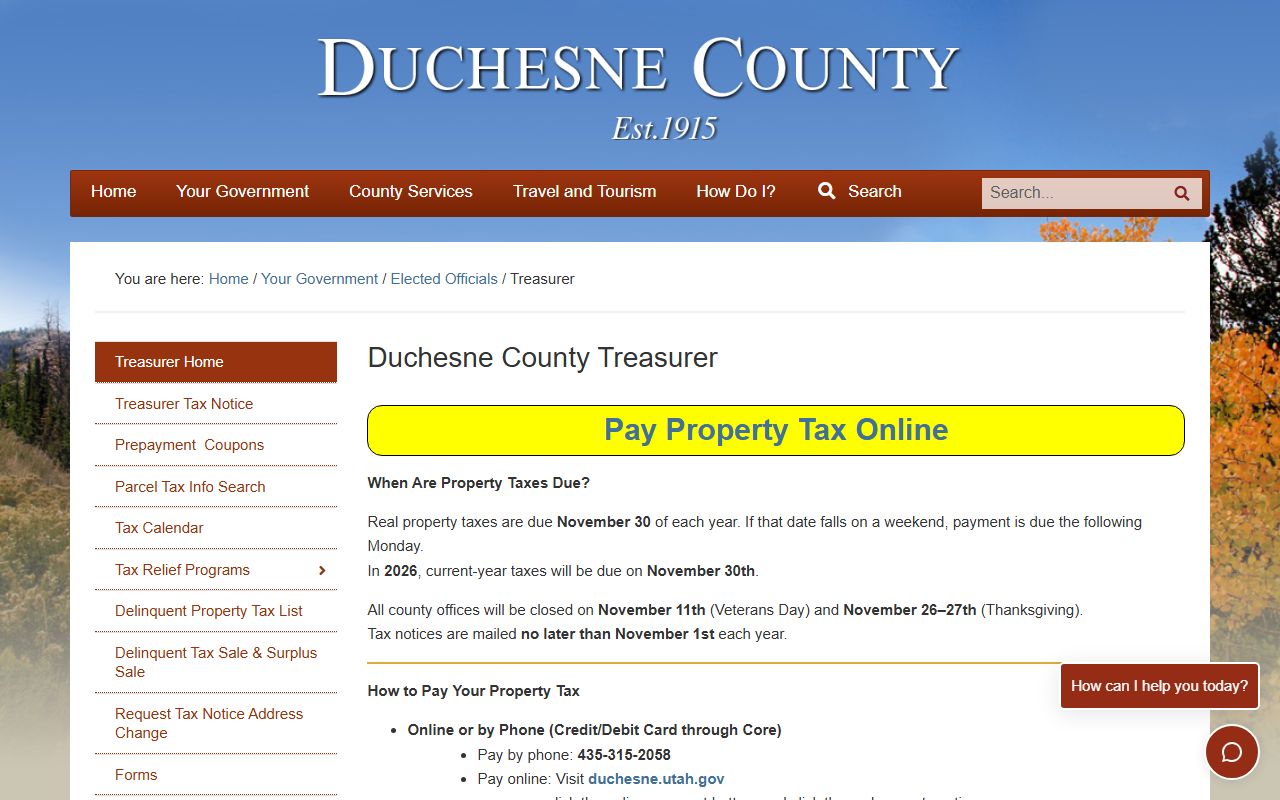
The Treasurer's office confirms current tax status and processes payments for all parcels in Duchesne County.
GIS and Parcel Maps for Duchesne County Property Records
Duchesne County maintains a geographic information system that shows property boundaries and ownership data. The Duchesne County GIS portal lets you find parcels on a map, see boundary lines, and pull up basic property information by clicking on any lot. This is one of the fastest ways to get a visual overview of property in Duchesne County.
GIS maps are especially useful in rural areas like much of Duchesne County, where parcel boundaries can be large and sometimes irregular. You can zoom in on any area, click a parcel, and see the assessor parcel number, owner name, and basic property data. From there you can pull up more detail through the Assessor's records. The Utah GIS portal also has statewide parcel data for those who want a broader view.
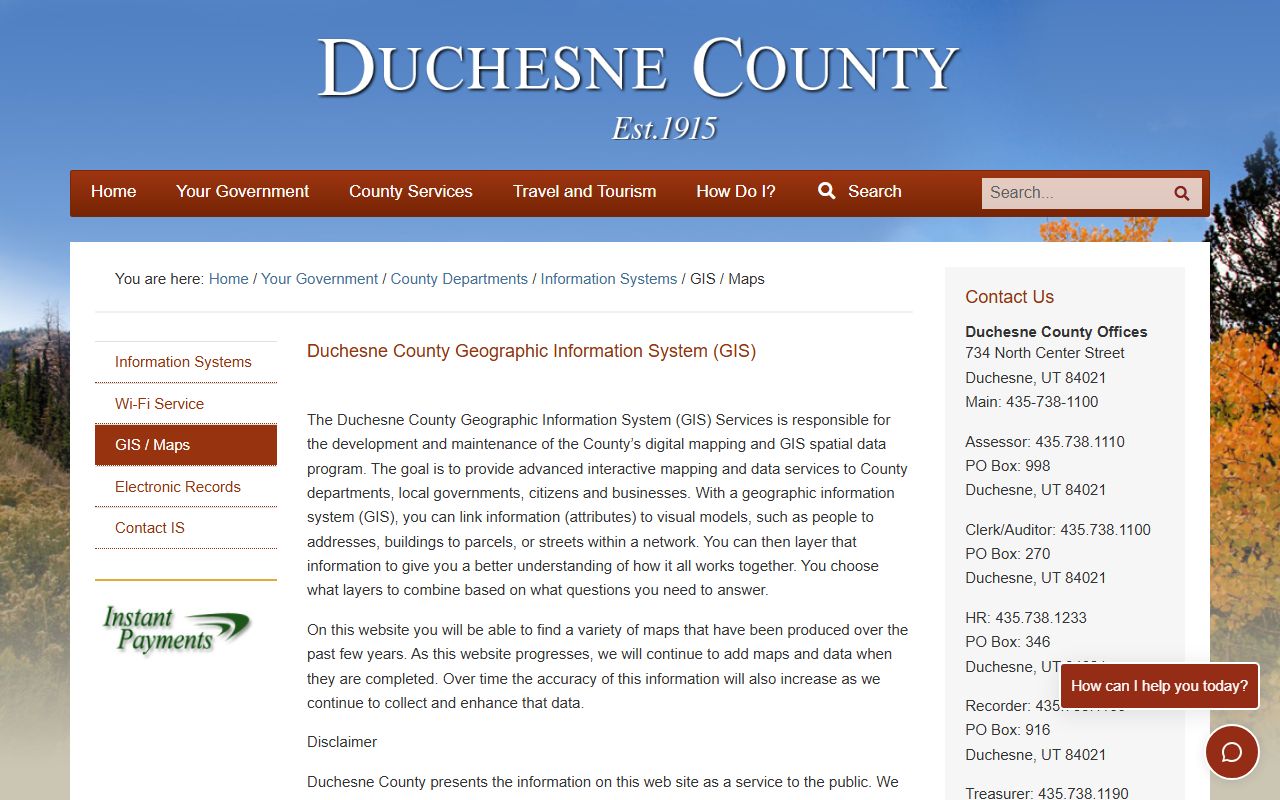
The GIS map is a quick way to identify parcels and pull up property tax data for any location in Duchesne County.
How Utah Property Tax Law Applies in Duchesne County
Utah assesses all property at 100% of fair market value. That rule comes from Utah Code Title 59, Chapter 2. The definitions section, Section 59-2-102, spells out what counts as real property versus personal property. Real property includes land, improvements, and minerals. Personal property includes business equipment and certain other tangible items. In Duchesne County, oil and gas rights fall under a special valuation method handled by the State Tax Commission.
Most homeowners in Duchesne County benefit from the primary residence exemption. This exemption reduces the taxable value of a qualifying home by 45%, meaning you only pay taxes on 55% of your home's fair market value. To get this exemption, the property must be your primary residence. You apply through the Assessor's office. The effective rate of 0.57% in Duchesne County is already relatively low, and the exemption reduces the tax burden further for owner-occupied homes.
The state requires county assessors to physically inspect and evaluate every property at least once every five years. This helps ensure that Duchesne County property values stay current and reflect real market conditions. If you think your assessed value is too high, you can appeal to the Duchesne County Board of Equalization. The appeal window opens after assessment notices go out in the spring. You can also compare rates across Utah's 29 counties at propertytax101.org.
Centrally assessed properties like pipelines, utilities, and oil and gas operations are reviewed by the Utah State Tax Commission's Property Tax Division. These owners can appeal their assessments by August 1 each year. Assessment notices for centrally assessed properties go out by May 1, and self-reporting affidavits are due by March 1.
Appealing Your Duchesne County Property Tax Assessment
If you disagree with your property's assessed value in Duchesne County, you have the right to appeal. The process starts with the Duchesne County Board of Equalization. You file your appeal within 45 days of the date shown on your assessment notice. The Board will hear your case and decide whether to adjust the value.
To make a strong appeal, bring comparable sales data for similar properties in Duchesne County. An independent appraisal also helps. The Board looks at market evidence, not just your opinion of value. If the Board denies your appeal, you can escalate to the Utah State Tax Commission's Property Tax Division for a further review. Keep copies of all documents you submit during this process.
Note: File your appeal within 45 days of receiving your assessment notice from the Duchesne County Assessor to preserve your right to challenge the value.
Cities in Duchesne County
Duchesne County has no cities that meet the population threshold for dedicated city pages on this site. The county seat is the town of Duchesne, which serves as the hub for all county offices and property tax services.
Nearby Counties
Duchesne County borders several other Utah counties. Property records for each are handled by their respective county offices.