
Search Wayne County Property Tax Records
Wayne County property tax records are managed by the county Assessor, Recorder, and Treasurer offices in Loa, Utah's most rural and sparsely populated counties, sitting in the south-central part of the state near Capitol Reef National Park. Wayne County has the second-lowest median property tax in Utah at just $563 per year, and its 0.34% effective rate is the second lowest in the state. If you need assessed values, ownership data, parcel information, or tax payment status for any Wayne County property, the offices at the county government center in Loa are the primary source. This page explains how to access those records and what to expect from Wayne County's property tax system.
Wayne County Quick Facts
Wayne County Assessor Office
The Wayne County Assessor's Office is responsible for assessing all taxable property in Wayne County, including residential homes, agricultural land, commercial properties, and vacant parcels. The Assessor maintains assessment records for every taxable parcel in the county and determines fair market value as of January 1 each year. The Assessor's portal is at wayne.utah.gov/assessor. For a county of Wayne's size and rural character, most Assessor functions are handled in person at the Loa offices, though online resources are available for basic record lookups.
All Wayne County properties are assessed at 100% of fair market value as required by Utah Code Title 59, Chapter 2. The Assessor uses comparable sales data where available, the cost approach for properties in areas with limited sales, and the income approach for commercial and income-producing properties. Wayne County's small and predominantly rural property market means that comparable sales data can be sparse in some areas, particularly for agricultural land and remote parcels near Capitol Reef. In those cases, the cost approach plays a more significant role in establishing value.
Wayne County's low median home value of $167,500 reflects the county's rural character. Most taxable property in Wayne County consists of agricultural land, modest homes in small communities like Loa, Bicknell, Teasdale, Torrey, and Hanksville, and scattered vacant parcels. The low median value is the primary driver behind the county's very low median annual tax of $563. Even a relatively low levy rate applied to a modest assessed value produces a small tax bill. For property owners coming from urban or suburban counties in Utah or other states, Wayne County's tax levels can seem remarkably low.
The Utah State Tax Commission provides oversight of Wayne County's Assessor just as it does for all 29 Utah counties. The Commission reviews assessment ratios to ensure Wayne County parcels are assessed close to 100% of market value, which can be challenging in a rural county with limited sales activity. The State Tax Commission portal at tax.utah.gov is the resource for state-level oversight, forms, and exemption applications.
The Utah State Tax Commission oversees all county assessors including Wayne County and provides the regulatory framework governing property assessment statewide.

The State Tax Commission at tax.utah.gov provides oversight of Wayne County's Assessor and is the authoritative source for primary residence exemption applications and other forms affecting Wayne County property owners.
Wayne County Recorder Office
The Wayne County Recorder maintains all official real property records in the county, including deeds, mortgages, trust deeds, liens, easements, plats, and other instruments affecting title. The Recorder's portal is at wayne.utah.gov/recorder. In a small rural county like Wayne, the Recorder's office manages a much smaller volume of instruments than urban counties, but the records it maintains are just as legally significant. Any deed, mortgage, or lien affecting a Wayne County property must be recorded here to be effective against third parties.
Recorded documents in Wayne County are indexed by grantor, grantee, document type, and recording date. Plat maps and subdivision records showing how parcels were divided are filed with the Recorder and provide the legal descriptions used on all subsequent deeds and tax documents. For agricultural parcels in Wayne County, the legal descriptions can be lengthy and specific, referencing township, range, and section data from the Public Land Survey System used in this part of Utah.
When a deed is recorded, the Recorder notifies the Assessor so that the ownership records on the tax roll are updated. In a small county, this coordination between Recorder and Assessor tends to happen quickly. If you purchase a Wayne County property and find that the Assessor still shows the previous owner, allow a few weeks for the update to process. For more complex transactions involving multiple parcels or unusual ownership structures, the update may take a bit longer.
Note: For older Wayne County property records that predate the digital era, in-person research at the Recorder's office in Loa is the most reliable approach, as some historical records may not be available in online systems.
Wayne County Treasurer and Property Taxes
The Wayne County Treasurer collects all property taxes billed to Wayne County parcels and distributes revenue to the taxing entities that serve each property. The Treasurer's portal is at wayne.utah.gov/treasurer. In a rural county with a modest tax roll, the Treasurer's operations are simpler than those of large urban counties, but the same legal requirements apply. Tax notices are mailed annually, and payment is due by the annual deadline or penalties and interest begin to accrue.
Wayne County property tax notices list the parcel number, legal description, assessed and taxable values, the levy rate for each taxing entity covering the parcel, and the total amount due. Taxing entities in Wayne County may include the county government, local school districts, and special service districts where applicable. With fewer layers of taxing entities than a city in an urban county, Wayne County parcels generally carry fewer line items on their tax bills. This is part of why the total tax burden in Wayne County is among the lowest in Utah.
Delinquent tax status in Wayne County is public record. The Treasurer tracks all overdue accounts. Properties with taxes delinquent for five or more years may face tax sale proceedings under Utah law. In a small county, tax sales are relatively infrequent, but the legal process and requirements are the same as in larger counties. If you are researching a Wayne County parcel and find delinquent taxes, contact the Treasurer's office for a current payoff amount including accrued interest and penalties.
Wayne County GIS and Parcel Maps
The Wayne County GIS division provides parcel mapping and spatial data tools at wayne.utah.gov/gis. The GIS system shows parcel boundaries, ownership, and property characteristics for parcels throughout the county. In a large, rural county like Wayne, where many parcels are remote and street addresses may not uniquely identify a location, the GIS mapping tools are especially valuable for confirming parcel boundaries and locating properties on the ground.
Wayne County parcels in rural and agricultural areas often have large lot sizes and share boundaries with federal and state land managed by agencies like the Bureau of Land Management, the National Park Service (Capitol Reef), and the Utah School and Institutional Trust Lands Administration. The GIS system can help distinguish privately owned taxable parcels from publicly owned non-taxable land, which is important for any research involving Wayne County property. The county's parcel layer shows only privately owned taxable parcels, while federal and state lands are shown as separate layers.
The Utah GIS Portal provides statewide parcel data that includes Wayne County parcels in a standardized format. For researchers who need to work with Wayne County parcel data alongside other Utah counties, the statewide portal's downloadable data is a convenient option. The portal is maintained by the State and updated regularly from county data submissions, so it generally reflects current ownership and parcel boundary information.
The Utah GIS Portal provides statewide parcel data including Wayne County parcels for researchers who need map-based property information.

The Utah GIS Portal at gis.utah.gov includes Wayne County parcel data in a format compatible with standard GIS tools and useful for large-area property research in this rural part of southern Utah.
Why Wayne County Property Taxes Are Low
Wayne County has the second-lowest median property tax in Utah at $563 per year and the second-lowest effective rate at 0.34%. Both figures are driven primarily by the county's low median home value of $167,500. Property tax bills are a product of assessed value multiplied by the levy rate. When values are low, even a modest rate produces a small tax bill. Wayne County's rural housing market, limited commercial development, and large amounts of non-taxable federal and state land all contribute to keeping property values well below those found in urban Utah counties.
The 45% primary residence exemption applies in Wayne County just as it does statewide. A primary residence valued at $167,500 has a taxable base of roughly $92,125 after the exemption. At the 0.34% effective rate, the annual tax on that property comes to about $313. Actual bills vary by location and which taxing entities cover a given parcel. Properties near Capitol Reef or in the Torrey area that have tourism-related value may have somewhat higher assessed values than the county median, while more remote agricultural parcels will generally be lower.
Agricultural land in Wayne County may qualify for the Green Belt exemption if it is actively used for farming or grazing. Under this exemption, qualifying land is assessed based on its agricultural use value rather than its market value. In a rural county where agricultural land may have some value to buyers seeking scenic land or recreational access, the Green Belt exemption can make a meaningful difference in the annual tax bill for a working farm or ranch. Property owners seeking this exemption should contact the Wayne County Assessor to apply and confirm the annual requirements for maintaining the exemption.
For a statewide comparison, the Utah property tax rates by county shows Wayne County ranked among the lowest effective rates in the state, alongside similarly rural counties in central and southern Utah.
Appealing a Wayne County Assessment
Wayne County property owners who disagree with the Assessor's valuation can appeal to the Wayne County Board of Equalization. The appeal must be filed within 45 days of the mailing date shown on the assessment notice. You submit a written request to the Board, and a hearing is scheduled where you can present your evidence. The process is the same as in all Utah counties, though the volume of appeals in a small rural county like Wayne is much lower than in urban counties.
In a county with limited comparable sales, building a strong appeal case can be more challenging than in a market with abundant sales data. Useful evidence includes any recent appraisal of your property by a licensed appraiser, sales of truly comparable properties in the area, or documentation of errors in the Assessor's records for your parcel. Physical errors like wrong square footage, incorrect year built, or wrong land area can directly affect the valuation and may be correctable without a full Board hearing by contacting the Assessor's office directly.
If the Board of Equalization does not resolve your concern, you can appeal to the Utah State Tax Commission Property Tax Division. The Commission hears formal appeals from taxpayers who have exhausted the county Board process. For Wayne County, where assessed values are already quite modest in most cases, formal State Tax Commission appeals are relatively rare. But the right to appeal exists for any Wayne County property owner who believes an assessment is incorrect.
The Utah State Tax Commission Property Tax Division is the final step in the Utah appeals process for Wayne County property owners who disagree with their county Board of Equalization ruling.
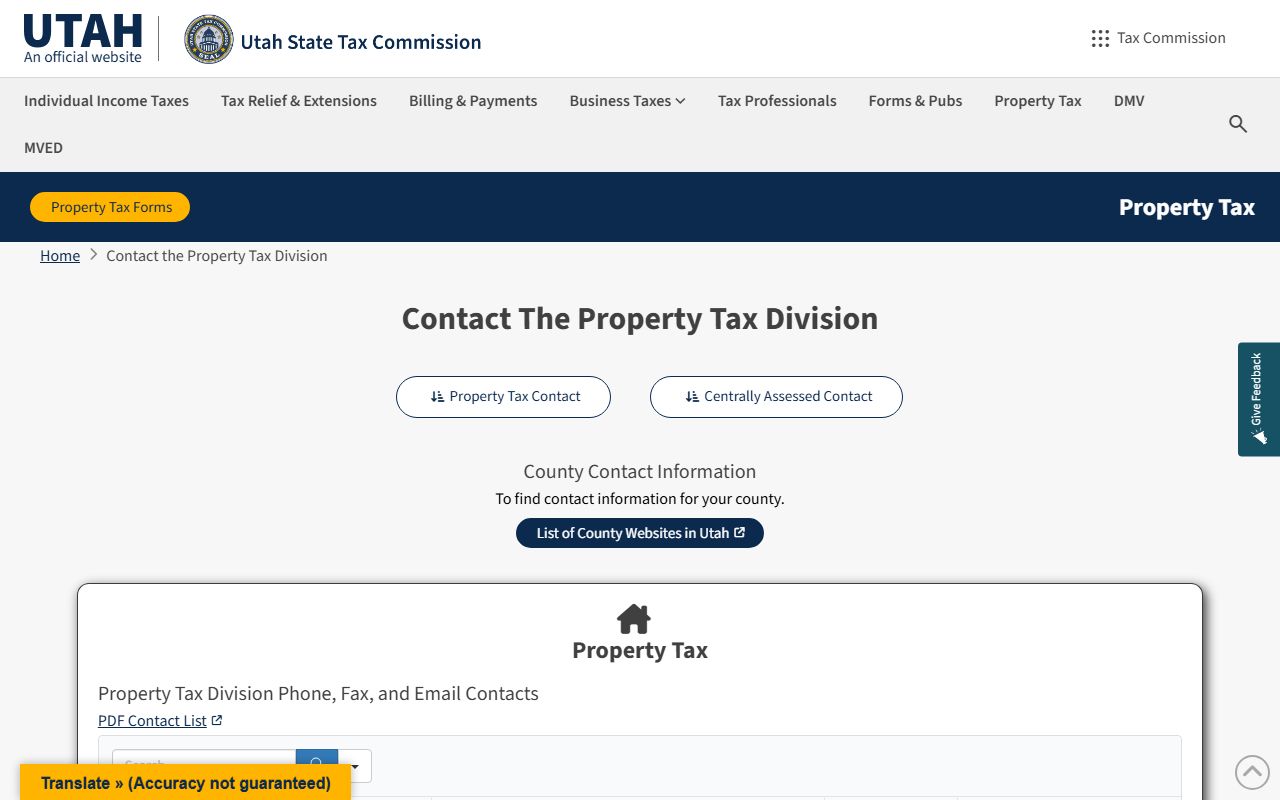
The Property Tax Division at the State Tax Commission hears formal appeals from Wayne County property owners who have gone through the county Board of Equalization and still disagree with their assessed value.
State Resources and Property Tax Code
The full legal framework governing Wayne County property taxes is in Utah Code Title 59, Chapter 2. This covers assessment standards, the primary residence and Green Belt exemptions, appeal procedures, and tax sale requirements. The same laws apply to Wayne County as to all 29 Utah counties. A supplementary reference is available through Justia's Utah Code index.
The centrally assessed property program handles utilities and multi-county entities operating in Wayne County. These include electric transmission lines and pipeline infrastructure that cross through rural southern Utah. The State Tax Commission values these centrally assessed properties and allocates revenue to the counties where they operate, including Wayne County. Property owners of centrally assessed property in Wayne County must file appeals directly with the Commission's Property Tax Division by August 1 each year.
The Utah property tax statistics overview puts Wayne County's low rates in statewide context, showing how its median tax and effective rate compare to all 29 Utah counties.
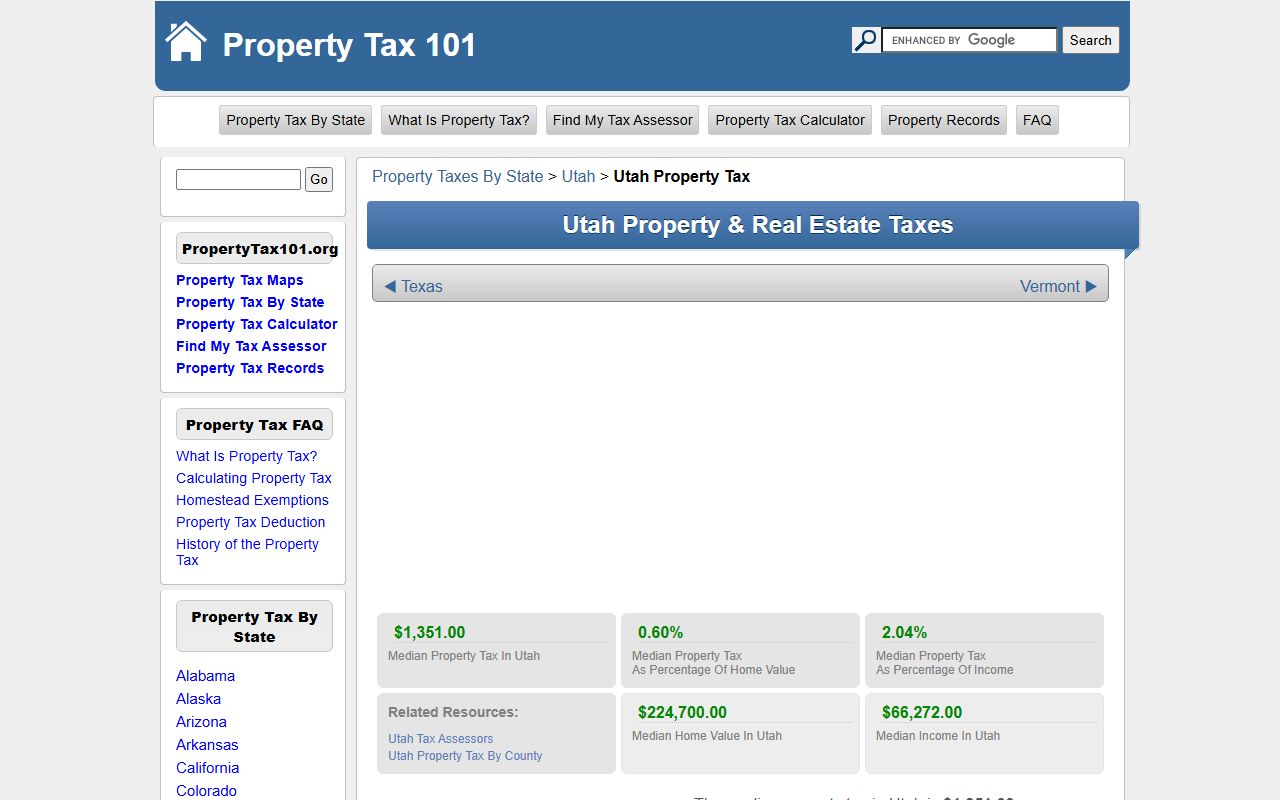
Utah statewide property tax statistics show Wayne County consistently among the lowest effective rates in Utah, alongside Piute and other rural south-central counties with modest property values.
Cities in Wayne County
Wayne County is entirely rural, and no cities within the county meet the population threshold for a dedicated city page on this site. The county seat is Loa. Other small communities in the county include Bicknell, Teasdale, Torrey, Hanksville, and Caineville. Property tax records for all properties in these communities are maintained by the Wayne County Assessor, Recorder, and Treasurer offices in Loa. Property owners in any Wayne County community should contact those offices directly for assessment, recording, and tax payment questions.
Nearby Counties
Wayne County borders Garfield County to the south and west, Sevier County to the north, Emery County to the northeast, Carbon County to the north, and San Juan County to the east. All of these counties handle their own property tax records through separate offices, though the rules and state-level oversight are uniform across all Utah counties.