
Weber County Property Tax Records
Weber County property tax records are managed by the county Assessor, Recorder, and Treasurer offices in Ogden on the northern Wasatch Front, covering parcels from the eastern shores of the Great Salt Lake to the Wasatch Mountains. Weber County has the highest effective property tax rate among Utah counties at 0.77%, which reflects a high concentration of taxing entities and service districts in an urban setting. If you need assessed values, parcel data, ownership history, delinquent tax status, or recorded documents for any Weber County property, this page covers all the offices and online tools that provide those records. Most Weber County property records are accessible online through the county's search systems.
Weber County Quick Facts
Weber County Main Website
Weber County's main website at co.weber.ut.us serves as the central hub for all county government services, including property-related tools and department links. The county was founded in 1850 and covers the area from the Great Salt Lake's eastern shores to the Wasatch Mountains, including Ogden, Roy, and the surrounding communities. The main website provides access to all three offices that handle property tax records: the Assessor, Recorder, and Treasurer.
Weber County's online services are well developed. Through the main portal, property owners can reach individual department tools for searching assessments, viewing recorded documents, checking tax balances, and accessing GIS parcel maps. The county's integrated approach means that a single research session starting at co.weber.ut.us can take you through all the steps needed to research a Weber County property without visiting multiple separate sites. This makes Weber County one of the more digitally accessible counties in Utah for property records research.
The Weber County main website is the starting point for property records research and connects users to all three primary offices: Assessor, Recorder, and Treasurer.
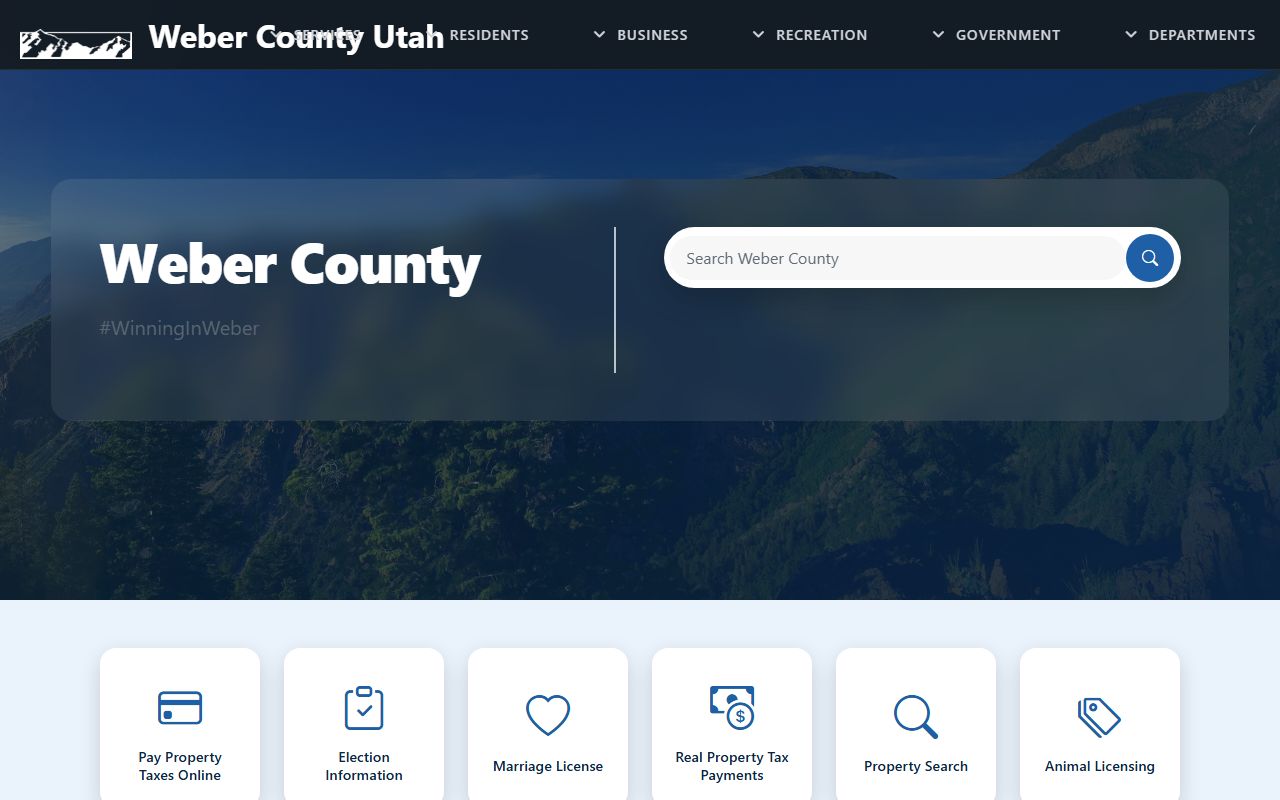
The Weber County main portal at co.weber.ut.us provides access to all county departments including the three offices central to property tax records research.
Weber County Assessor Office
The Weber County Assessor's Office determines property values for all taxable real property in the county. The Assessor maintains detailed records on every parcel and conducts annual assessments consistent with Utah law. The Assessor's portal is at co.weber.ut.us/assessor. The office provides a robust set of online search tools that give users access to a broad range of property data without requiring an in-person visit.
Weber County Assessor search capabilities are extensive. You can search by parcel number, either full or partial, by property address, by owner name, by subdivision name, or through map-based selection using an interactive parcel map. Each search method returns a list of matching parcels, and you click through to the detail page for the specific property you are researching. The map-based selection tool is useful when you know the location but not the exact address or parcel number.
Assessment details available for each Weber County parcel include the current year assessed value, the previous year assessed value, the percentage change between years, land value listed separately from improvement value, market value compared to taxable value, and a new growth indicator showing whether the parcel was newly added to the roll. These fields let you see not just what a property is assessed at, but how that value has moved over time and whether the property was recently developed or subdivided.
Property characteristics available through the Assessor's system cover a detailed profile of each parcel. For residential properties, this includes lot size in both acres and square feet, building square footage, year built, construction type, number of stories, bedroom count, bathroom count, basement finish percentage, garage capacity, outbuildings such as sheds or barns, and special features including pools and decks. These data fields feed directly into the computer-assisted mass appraisal model the Assessor uses to set values. Reviewing your parcel's data for accuracy is a useful first step if you think your assessment is too high, since errors in any of these fields can affect the final value.
Tax information available through the Assessor's system includes the current year tax amount, tax district codes identifying which taxing entities cover the parcel, exemption amounts applied to the value, the final taxable value after exemptions, and payment status showing whether current taxes are paid, unpaid, or delinquent. All properties in Weber County are assessed at 100% of fair market value as of January 1 under Utah Code Title 59, Chapter 2.
The Weber County Assessor's portal shows the full range of search tools and assessment data available for all county parcels.
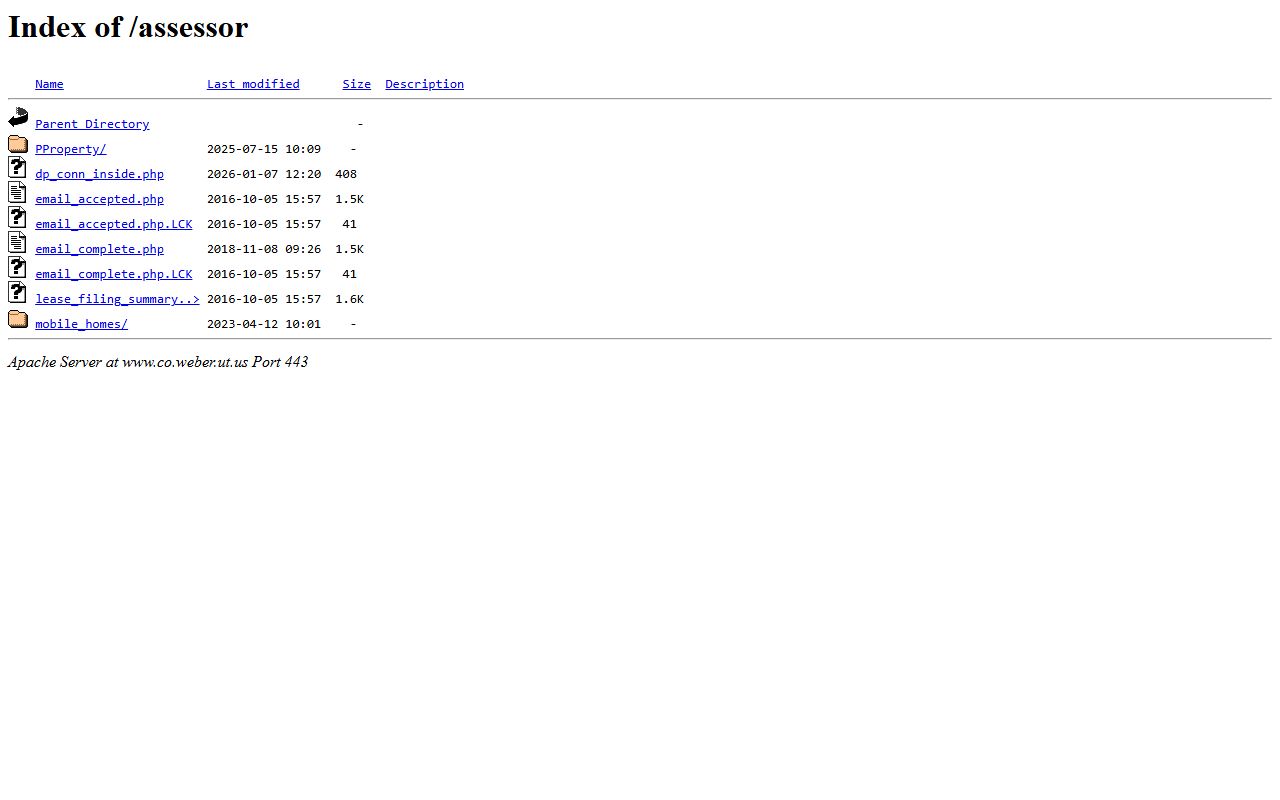
The Assessor's online system at co.weber.ut.us/assessor provides detailed assessment data, property characteristics, and tax district information for every taxable parcel in Weber County.
Weber County Recorder and Property Documents
The Weber County Recorder's Office maintains all official real property records in the county, including deeds, mortgages, trust deeds, liens, easements, plats, and other instruments affecting title. The Recorder's portal is at co.weber.ut.us/recorder. Online document search is available, allowing users to search by party name, recording date range, or document type to find recorded instruments. The grantor-grantee index covers recent recordings with document images available for most.
The Recorder maintains a comprehensive index of all recorded instruments in Weber County. You can search by grantor name to find all documents recorded by a particular party, by grantee name to find documents received by a particular party, or by parcel number to pull all instruments associated with a specific property. Document images for recent recordings are available online, which allows you to view the full text of a deed, mortgage, or lien without visiting the office. For historical access to older records that predate the digital imaging system, an in-person visit to the Recorder's office in Ogden is required.
Plat maps and subdivision records are filed with the Recorder and establish the legal descriptions used on all subsequent deeds and tax documents for parcels in each development. In Weber County, which includes established older neighborhoods in Ogden and newer developments in surrounding communities, the Recorder's plat records provide the foundational legal framework for all those parcels. Copies of recorded documents are available through the online portal or in person. Copy fees apply for certified copies and for older records outside the online system.
Note: When a deed is recorded in Weber County, the Recorder forwards ownership information to the Assessor so that the tax roll reflects the new owner. If you record a deed and the Assessor still shows the previous owner, allow a few weeks for the update to appear in the online system.
Weber County Treasurer and Tax Payments
The Weber County Treasurer collects property taxes for all parcels in the county and distributes revenues to the taxing entities covering each property. The Treasurer's portal at co.weber.ut.us/treasurer provides a full set of online property tax tools for Weber County property owners and researchers. Services include online tax payment, tax history lookup by parcel, delinquent tax search, tax sale information, and payoff quote requests for properties with outstanding balances.
Online payment options through the Weber County Treasurer portal accept credit cards and e-checks. You can pay current year taxes, prior year delinquent taxes, or request a payoff quote to bring an account fully current. The payment system is available 24 hours a day, which is useful for anyone working against a deadline such as a property closing or a tax sale redemption deadline. In-person payment at the Treasurer's office in Ogden and mail-in payment are also accepted.
Annual tax notices in Weber County list the parcel number, legal description, assessed and taxable values, the levy rate for each taxing entity covering the parcel, and the total amount due. Weber County parcels may carry levies from the county government, Ogden City or Roy City if within city limits, multiple school districts, water districts, sewer districts, fire protection districts, library districts, transit districts, and other special service districts. The number of taxing entities layered on a single Weber County parcel depends on its location and which service districts serve it. Urban parcels in Ogden and Roy can have more entities than unincorporated parcels in rural parts of the county.
Delinquent tax status is public record in Weber County. The Treasurer tracks all overdue accounts, and that information is searchable online through the Treasurer's portal. Properties with taxes delinquent for five or more years may be subject to tax sale proceedings. Weber County conducts annual tax sales on eligible properties. Before a sale, property owners receive notice and have a redemption period to pay the delinquent amount in full. Contact the Treasurer's office for current payoff amounts on any delinquent account, since interest and penalties continue to grow from the time of the last system update.
The Weber County Treasurer's portal provides online payment, tax history, and delinquency information for all parcels in the county.
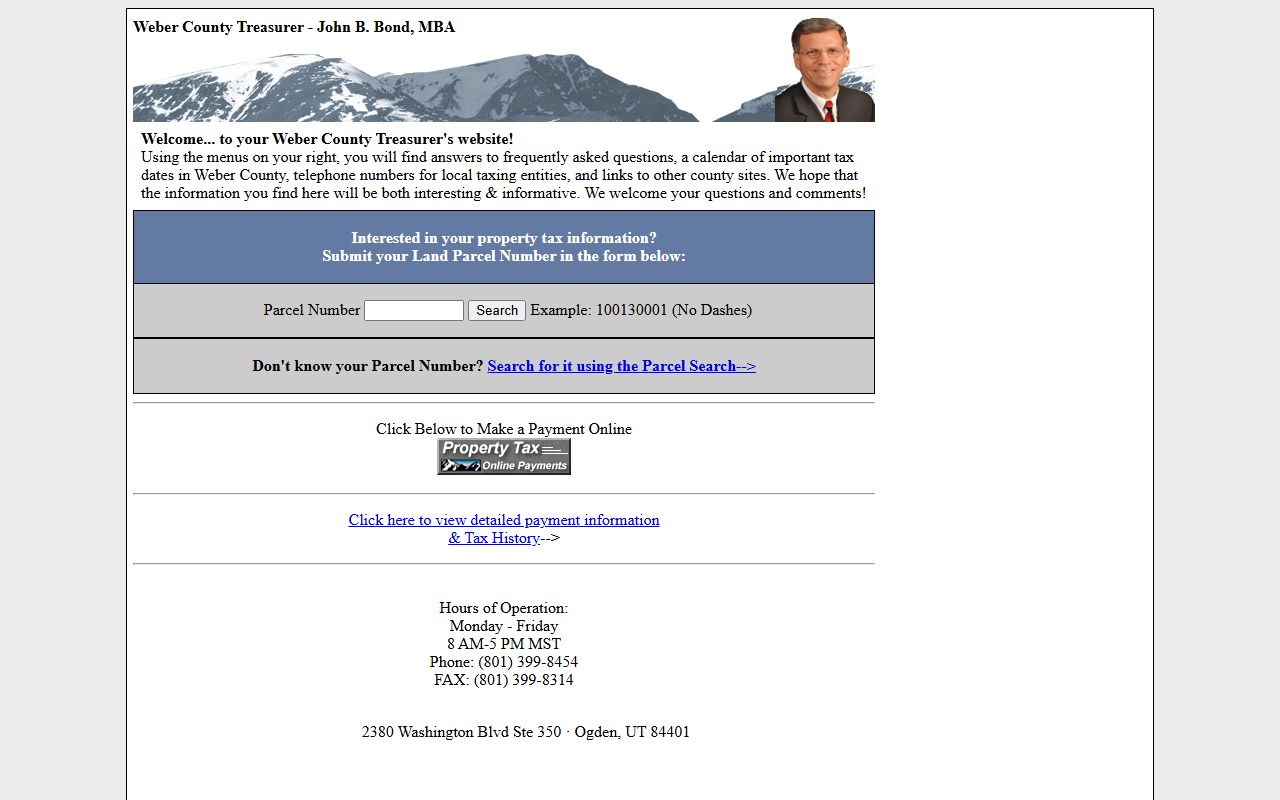
The Treasurer's portal at co.weber.ut.us/treasurer lets Weber County property owners pay taxes online, look up tax history, check delinquent status, and request payoff quotes at any time.
Weber County GIS and Parcel Maps
The Weber County GIS division provides parcel mapping tools and spatial data at co.weber.ut.us/gis. The GIS system shows parcel boundaries, ownership information, and property characteristics for all parcels in the county. The map-based parcel search in the Assessor's system is built on this GIS data, allowing users to click on any location on the map and retrieve assessment information for the parcel at that location.
Weber County's GIS parcel layer is built from the Recorder's official boundary data and linked to the Assessor's tax roll attributes. This means a GIS search returns both the spatial location and the key assessment data for a parcel. For property research in a county with diverse parcel types ranging from small urban lots in Ogden to larger agricultural parcels and mountain properties in the eastern part of the county, the GIS tools provide a consistent way to locate and identify properties regardless of type or size.
The Utah GIS Portal provides statewide parcel data that includes Weber County parcels in a standardized format. This is useful for researchers who need bulk parcel data or who need to cross county lines in their research. The statewide layer is updated from county submissions and generally reflects current ownership and boundary data for Weber County parcels.
Why Weber County Has the Highest Effective Rate in Utah
Weber County's 0.77% effective rate is the highest of any county in Utah. This stands out because the county's median home value of $168,300 is among the more modest in the state, yet the median annual tax of $1,289 is comparable to counties with much higher home values. The reason is that the combined levy rate from all taxing entities covering Weber County parcels is higher than in any other Utah county.
Weber County's higher levy reflects the density of taxing entities in an urban, established community. Ogden is one of Utah's older cities with a full set of municipal services, school districts, and special service districts that all carry levy rates. When you add the county levy, the Ogden City levy, school district levies, water district levies, sewer district levies, transit district levies, and other special service districts together, the combined rate applied to taxable value is substantially higher than in less urbanized counties with fewer service layers. A parcel in rural Millard County or Wayne County may have only a handful of taxing entities, while an Ogden parcel can have a dozen or more.
The math is straightforward. With a median home value of $168,300 and the 45% primary residence exemption, the taxable base is roughly $92,565. At the 0.77% effective rate, the annual tax comes to about $713 at the median. But the effective rate figure reflects an average across the entire county, and actual bills vary by location within Weber County. Properties in areas with more service districts pay more. Properties in unincorporated Weber County with fewer overlapping entities pay less. The $1,289 median figure reflects the actual distribution of tax bills across the county's parcels, which skews toward the more populated urban areas where levy rates are highest.
Truth in Taxation rules apply to all Weber County taxing entities. Any entity that wants to collect more total revenue than the prior year must publish notice and hold a public hearing before the rate increase takes effect. This gives property owners a chance to comment and pushes back against automatic rate creep. But even with Truth in Taxation, the accumulated levy of many separate entities each making small adjustments over time contributes to Weber County's position as Utah's highest-rate county.
For statewide comparison, see the Utah property tax rates by county overview. The broader Utah property tax overview explains how the state system works and why urban counties tend to have higher effective rates than rural ones.
How Weber County Property Tax Is Calculated
Weber County property taxes follow the standard Utah three-step process. The Assessor sets the fair market value of each property as of January 1. For primary residences, that value is multiplied by 55% to get the taxable assessed value, since 45% is exempt under Utah's primary residence exemption. The combined levy rate from all taxing entities covering your parcel is then applied to the taxable value to produce the annual tax bill. Non-primary-residence properties are taxed on 100% of assessed value.
The primary residence exemption is worth applying for if you own and live in a Weber County home. The application is available through the Utah State Tax Commission. Without it, your home is taxed at 100% of assessed value rather than 55%, which at Weber County's effective rate makes a significant difference in the annual bill. If you recently purchased a Weber County home and did not file the exemption in your first year of ownership, you may be able to retroactively apply for prior years depending on circumstances. Contact the Assessor's office or the State Tax Commission for guidance.
Taxes on Weber County investment properties, rental homes, and vacation properties are calculated on 100% of assessed value since they do not qualify for the primary residence exemption. At the 0.77% effective rate, a $168,300 rental property in Weber County carries a tax bill of roughly $1,296 annually on the full value. That compares to about $713 for the same property if it were an owner-occupied primary residence with the exemption applied. The difference matters for real estate investors evaluating Weber County cash flow projections.
Appealing a Weber County Assessment
Weber County property owners who believe the Assessor has overvalued their property can appeal to the Weber County Board of Equalization. The appeal deadline is 45 days from the mailing date shown on your assessment notice. A written request to the Board starts the process, and a hearing is scheduled where you can present your evidence. There is no cost to file a Board of Equalization appeal.
Because the Weber County Assessor's system stores detailed property characteristics including square footage, year built, bedroom and bathroom counts, basement finish percentage, garage capacity, and special features, reviewing those data fields is a practical first step. If any field is wrong, the valuation model will produce an inaccurate result. A simple data correction through the Assessor's office may resolve the issue without a full Board hearing. If the data is accurate but you still believe the value is too high, recent comparable sales showing lower values for similar properties in your area are the strongest evidence at the Board of Equalization level. An independent licensed appraisal is also accepted.
After a Board of Equalization ruling, taxpayers who still disagree can appeal to the Utah State Tax Commission Property Tax Division. The Commission hears formal appeals and can order the county Assessor to adjust a value if it finds the county's assessment inconsistent with state law. The Commission also handles appeals for centrally assessed properties like utilities and railroads that operate in Weber County. These properties are valued at the state level through the centrally assessed property program rather than by the county Assessor.
Utah State Tax Commission and Weber County
The Utah State Tax Commission oversees the Weber County Assessor along with all other Utah county assessors. The Commission conducts ratio studies that compare assessed values to actual sales prices to verify that counties are assessing at or near 100% of market value. Weber County's high levy rate makes accurate assessments particularly important, since over-assessment at a high levy rate produces a proportionally larger tax overcharge than in low-rate counties.
The State Tax Commission's Property Tax Division at tax.utah.gov/contact/property-tax is the contact point for formal assessment appeals, exemption questions, and inquiries about centrally assessed property in Weber County. The Commission is located at 210 North 1950 West, Salt Lake City, Utah 84134, phone 801-297-2200. For most Weber County property owners, interactions with the State Tax Commission are limited to filing the primary residence exemption application and, if needed, pursuing a formal appeal after the county Board of Equalization process.
The full Utah property tax code at le.utah.gov governs all aspects of Weber County property taxation. For a plain-language version of key statutes, Justia's Utah Code index provides an accessible reference.
The Utah State Tax Commission portal is the authoritative source for state-level property tax oversight, forms, and guidance affecting Weber County property owners.

The State Tax Commission at tax.utah.gov oversees the Weber County Assessor, provides the primary residence exemption application, and is the final appeal destination for Weber County property owners who exhaust the county Board of Equalization process.
The centrally assessed property system handles utilities and multi-county entities operating within Weber County's boundaries.
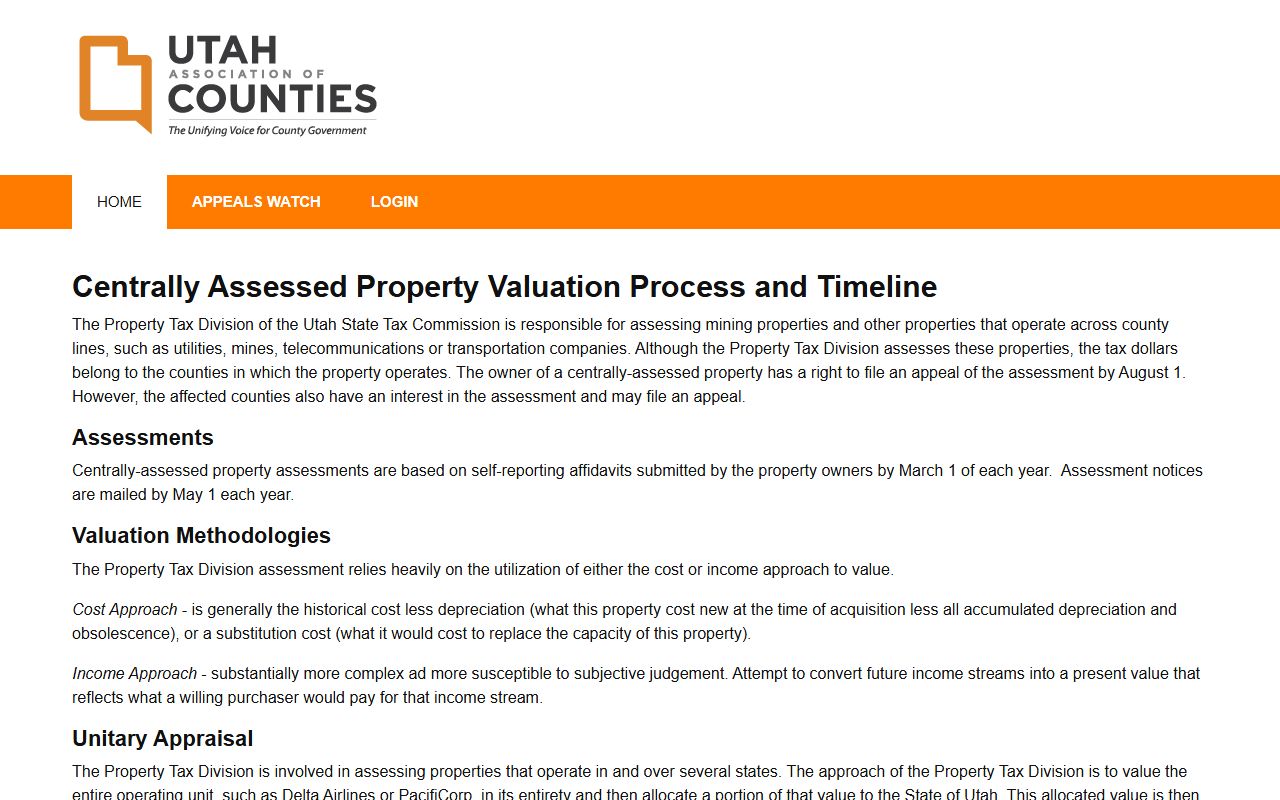
Utilities, railroads, and telecommunications companies operating in Weber County are valued through the centrally assessed property program at the State Tax Commission rather than by the Weber County Assessor directly.
Cities in Weber County
Weber County includes two cities with dedicated pages on this site. Ogden is the county seat, one of Utah's oldest cities, and the largest city in Weber County. Roy is a significant community just south of Ogden. Both city pages provide property-specific information including courthouse details, local resources, and county office contacts. All property tax records for properties within Ogden or Roy are maintained by the Weber County Assessor, Recorder, and Treasurer offices described on this page.
Nearby Counties
Weber County borders Davis County to the south, Box Elder County to the northwest, Morgan County to the east, Cache County to the north, and Rich County to the northeast. Davis County is directly adjacent and is another high-density Wasatch Front county with significant property tax records activity.